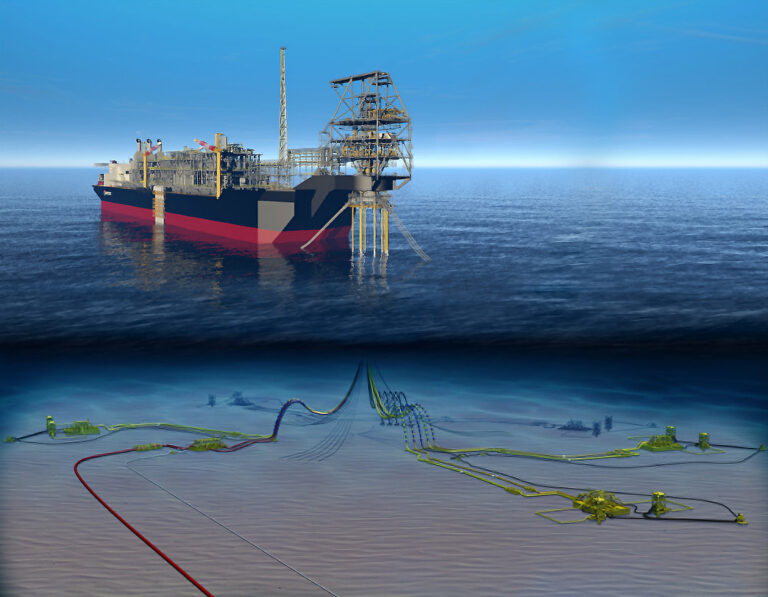
July 21 (PN) Brazil was home to the major large-scale offshore projects that reached a final investment decision (FID) in 2025, according to the third edition of the State of Exploration series released by the consultancy Westwood. The report analyzes the evolution of high-impact discoveries made between 2010 and 2025 and assesses the industry’s ability to effectively bring them to fruition and into the production phase.
The first major project of note was the investment decision for Sergipe Deepwater (SEAP). The venture stemmed from the Moita Bonita discovery, made in 2012 in the Sergipe-Alagoas Basin. Operated by Petrobras, SEAP holds approximately 870 million barrels of oil equivalent (boe); its final investment decision was approved in December 2025, following years of studies to make the complex ultra-deepwater development viable.
The second highlight was the Gato do Mato project, operated by Shell in the Santos Basin. Discovered in 2010, the gas-condensate field faced technical challenges associated with deepwater operations before receiving final development approval in March 2025.
Outside Brazil, Westwood highlights the approval of the development of bp’s Tiber-Guadalupe cluster in the Gulf of Mexico, which holds 500 million barrels of oil equivalent. The discoveries, made in 2009 and 2014, were once considered economically unviable due to extreme reservoir pressure conditions—exceeding 20,000 psi—and high development costs. According to Westwood, recent technological advances in ultra-high-pressure reservoir exploration have enabled the project to move forward, with production expected to begin in 2030.
The study indicates that 11 major offshore discoveries, spanning eight projects, advanced to the development phase in 2025. Collectively, they represent 2.3 billion barrels of oil and 9.5 trillion cubic feet (tcf) of natural gas in discovered resources, while adding approximately 800,000 barrels of oil equivalent per day (boe/d) of new production capacity.
Another example is the Sea Lion project in the Falkland Islands, discovered in 2010. The venture faced challenges related to its remote location, supply chain constraints, and sovereignty disputes between the United Kingdom and Argentina. Following changes in ownership structure, Navitas approved the final investment decision in December 2025, with production expected to start in 2028.
PAST DISCOVERIES, NEW OPPORTUNITIES
Westwood highlights that most of these discoveries took over a decade to reach a final investment decision. Of the 11 discoveries that advanced in 2025, eight were made prior to 2014. Among the more recent ones are two gas fields in the Black Sea (Turkey) and an oil discovery in Guyana.
According to the consultancy, oil companies have stepped up efforts in recent years to expand their reserves. While exploration remains a key avenue, there is growing interest in unlocking previously complex discoveries—driven by new technologies, revised development models, new partnerships, and more favorable fiscal conditions.
Despite the progress made in 2025, Westwood notes that a substantial volume of resources is still awaiting a final investment decision. According to the study, there are 57 discoveries made between 2010 and 2015—representing approximately 4.7 billion barrels of oil and 125 trillion cubic feet of natural gas—that have not yet reached Final Investment Decision (FID).
In the consultancy’s assessment, given the trend of declining annual major discoveries and the lack of expectations for significant growth in high-impact exploration activity, companies should focus their efforts on making discoveries from over a decade ago viable, utilizing new technologies and development models to convert known resources into commercial production.
 Brazil Energy Insight
Leave a comment