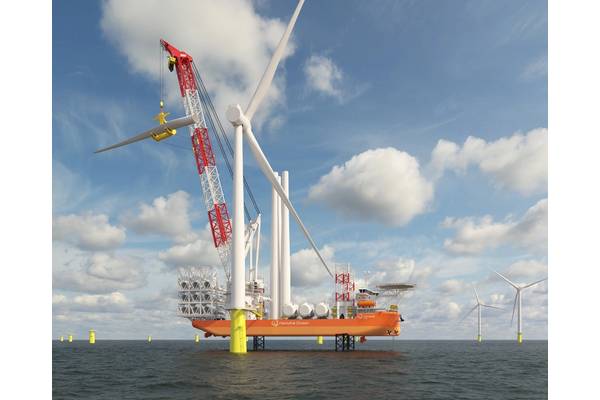
The changing global bottom-fixed offshore wind turbine and foundation installation market
May 1 (OE) The last two or three years have seen a change in the underlying stakeholder support for the energy transition, resulting in the energy trilemma being focused more on energy security and affordability than transition, which means a pivot away from renewables to increased support for oil & gas. At the same time, inflation and interest rates have impacted project economics. Needless to say, these factors have impacted the global offshore wind forecast and the supply and demand balance for wind turbine installation and major component exchange (MCE) and foundation installation..
It is not all bad news.
The UK and North Seas European countries are planning to increase offshore wind capacity (to increase energy security and affordability through scale) and advance grid integration (to manage localized offshore wind farm intermittency and stabilize the grid). Poland is advancing its offshore wind agenda. Mediterranean countries will enter the market. The big three EAPAC players (Japan, South Korea and Taiwan) will continue to advance offshore wind auctions and capacity development and will soon be joined by Australia and the Philippines. In North America (NAM) Atlantic Canada is looking to fill some of the hole left by the withdrawal of the USA from offshore wind, South America (SAM) is moving through the gears to establish offshore wind markets, and India (ISC) may soon turn plans into auctions.
This ever-changing market has an impact on the wind turbine and foundation installation market, where investment decisions for the latest generation vessels were generally made in more stable and promising times. As a result, utilization could be challenging, impacting day rates and financial returns.
These are some of the findings from a new bottom-up analysis and report by Intelatus Global Partners of the bottom-fixed turbine and foundation installation and maintenance market.
Changing demand has impacted the wind turbine and foundation installation supply & demand balance, resulting in tight to over-supply during the forecast period.
The global offshore wind forecast (excl. China) has “moved to the right” over the last year or so due to cancelled projects, disappointing auctions, cost increases and political headwinds.
The 2035 commissioned capacity forecast is ~230GW, of which over 90% features bottom-fixed technology. Europe accounts for over 70% of capacity additions and EAPAC 20%. In NAM, the project pipeline has been severely impacted by the current federal administration’s campaign against offshore wind projects and Canada looks to make a market entry in the next decade. Other new demand is forecast to emerge in SAM and ISC towards the middle of the next decade.
Read full article: https://www.oedigital.com/news/538691-vessel-sector-deep-dive-wtivs


Leave a comment