April 9 (oilprice.com) The latest global oil shock has created an ideal environment for Suriname’s struggling oil boom. The impoverished South American country of less than seven hundred thousand is endeavoring to launch a transformative oil boom. Poor drilling results, a high gas-to-oil ratio, and conflicting seismic data saw Suriname’s oil boom put on hold during 2022. There are, however, obvious signs that the development of offshore Block 58 is back on track. Iran’s closure of the Strait of Hormuz, after U.S. and Israeli airstrikes, will drive higher investment in oil-producing countries that do not require access to that body of water to ship their petroleum to export markets.
Suriname’s long quest to ignite an oil boom on the scale of neighboring Guyana began in 2020 with the Maka-1 discovery in the 1.4-million-acre Block 58. This was followed by four further major discoveries in the oil acreage, giving Suriname’s government, in the capital Paramaribo, hope of an economically transformative oil boom emerging. The prospect of such an event occurring was bolstered by neighboring Guyana, where an epic offshore oil boom, centered on the prolific Stabroek Block, has transformed the once poverty-stricken nation.
Since production began in 2019, Guyana’s gross domestic product has grown fivefold to over $25 billion for 2025. The tiny former British colony is now the wealthiest country by GDP per capita in South America and the 10th richest globally. Suriname shares the offshore Guyana Suriname oil basin, which is turning into a prolific drilling location, with Guyana. Discoveries to date are estimated to contain more petroleum than the U.S. Geological Survey projected in the government department’s last assessment of the oil-bearing region.
The Stabroek Block alone is estimated to contain at least 11 billion barrels of crude oil. Importantly, this proven prolific oil acreage is contiguous to Suriname’s offshore Block 58, which analysts estimate could contain as much as 6 billion barrels of petroleum. The oil-rich fairway running through the Stabroek Block extends into Block 58, and TotalEnergies discoveries in that acreage attest to that assertion.
In the latest positive development for Suriname’s burgeoning oil boom, TotalEnergies Suriname general manager Artur Nunes de Silvar recently announced the 220,000-barrel-per-day Gran Morgu development was 50% complete. The completion of this facility is crucial to launching Suriname’s oil boom. Gran Morgu, located roughly 93 miles or 150 kilometers off the coast of Suriname, is a project developing the Sapakara and Krabdagu oilfields in Block 58, which contain an estimated 760 million barrels.
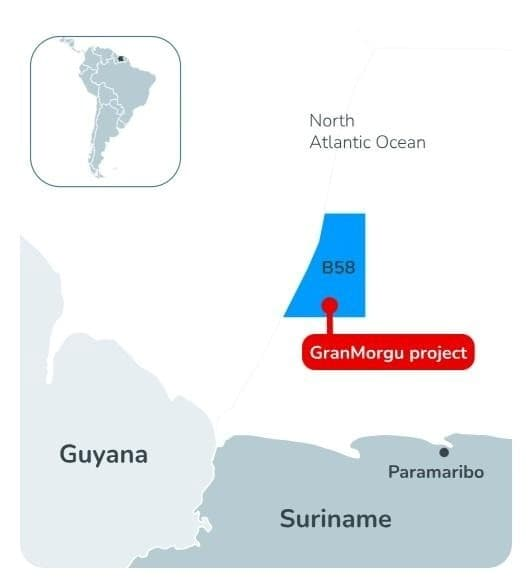
Source: TotalEnergies.
The $10.5 billion facility is expected to produce first oil in 2028, around eight years after the first discovery in offshore Suriname. This will generate up to $26 billion in revenue for Suriname and be responsible for the GDP growing by up to 55% once full operational capacity is reached.
Malaysia’s state-controlled energy company Petronas plans to make a final investment decision (FID) this year regarding the development of Block 52 offshore Suriname. Since 2013, the state-owned driller has made three significant discoveries in the block. This follows on from Petronas and Suriname’s national oil company (NOC) and hydrocarbon regulator, Staatsolie, declaring the commerciality of Block 52’s Sloanea natural gas field toward the end of 2025.
The development of that project will give Suriname’s hydrocarbon boom a leg-up while improving energy security in South America and the Caribbean, particularly with oil and natural gas production from Trinidad and Tobago in decline. This, indeed, is an important aspect of Suriname’s burgeoning oil boom; it will enhance energy security in the Americas by boosting regional production, which is not dependent on being shipped via the strife-torn Middle East to reach export markets. Indeed, South America is fast becoming a regional energy powerhouse with Argentina, Brazil, and Guyana all experiencing major hydrocarbon booms, which are lifting production to record levels.
Guyana’s emergence as a major hydrocarbon exporter underscores Suriname’s petroleum potential. Oil cargoes to the U.S. are soaring as production grows, with 2025 shipments rising by 18% year over year to 208,000 barrels per day, which is surprisingly eight times greater than five years earlier. Petroleum cargoes from Brazil and Venezuela are also rising by a stunning 24% and 46% month over month, respectively, for January 2026. Those numbers demonstrate the considerable opportunity for Suriname to bolster energy security in the Americas while building an economically transformative energy boom that will lift the country out of poverty.
By Matthew Smith
 Brazil Energy Insight
Leave a comment