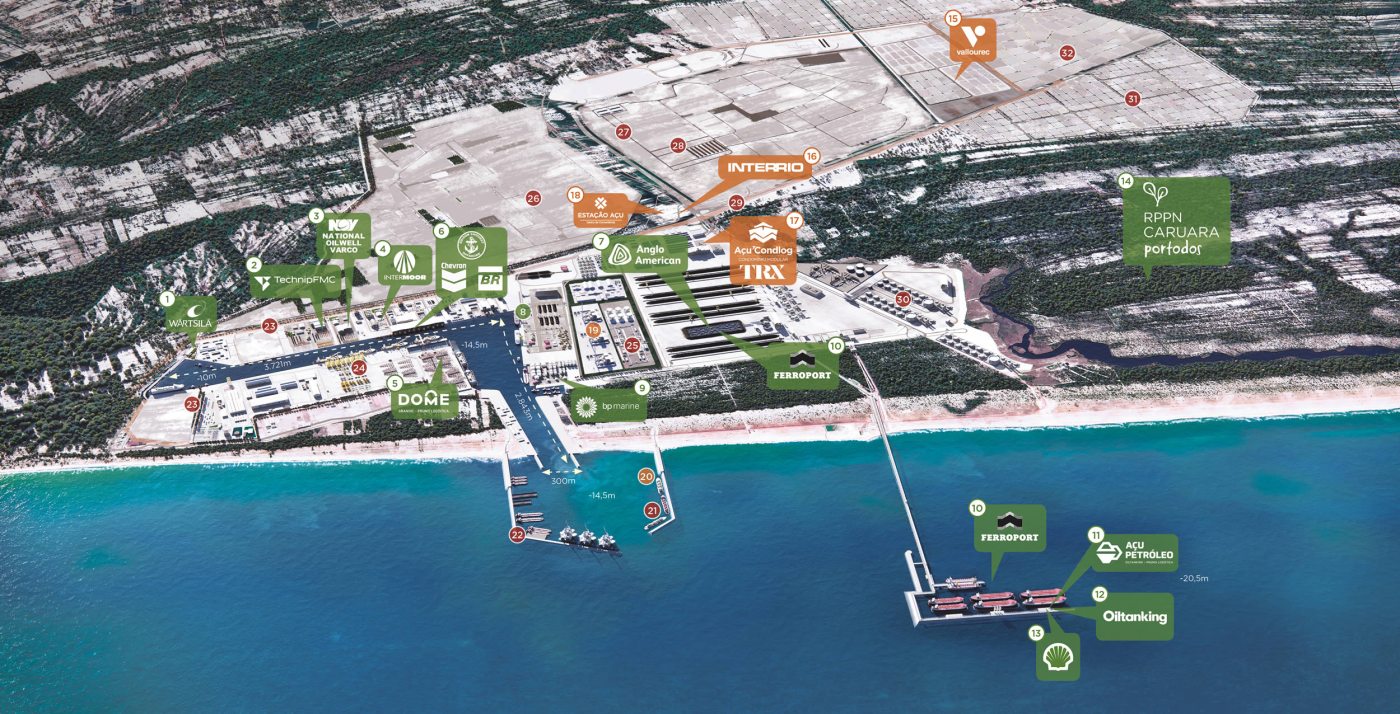
Fifteen years and R$ 20 billion later, Porto do Açu, a mega-complex port-industry is already among the ten largest in the country in terms of cargo handled. It has already contracted over R$ 22 billion in investments over the next five years.
Prumo Logística, owner of the venture, controlled by the American fund EIG, is betting on the transition to a low-carbon economy to attract even more investments. The plans include becoming the largest offshore wind energy hub in the country and receiving green hydrogen production plants.
“Our focus is to develop in Porto do Açu the main low carbon business hub in Latin America and one of the main ones in the world”, says Rogério Zampronha, president of Prumo Logística, which today has the Mubadala, Abu Dhabi’s multibillion-dollar sovereign wealth fund as partner. “The new strategy is the industry based on energy transformation. It is not a transformation, it is a revolution, the opening of a new market for a new Brazil. This can be as relevant to the Brazilian economy as agribusiness is today”, he adds.
For now, there are 19 companies installed in the complex, which employ 7,000 workers and hire around 300 suppliers. The highlights are Ferroport – an iron ore export terminal for the Minas-Rio System, now controlled by Anglo American mining company – and a terminal for transshipment of oil – which already accounts for around 30% of Brazilian exports of crude oil. With them at the forefront, Açu handled 55.7 million tons in 2021, seventh among the largest ports in the country, according to data from the National Water Transport Agency (Antaq), aggregated by port complex. This year, in the accumulated until July, Açu is in eighth position.
The complex also houses the largest base in the world of the provider of support services for the oil industry, Edison Chouest Offshore, and a thermoelectric generation park, of Gás Natural Açu (GNA), a partnership of Prumo Logística with Siemens, BP and Chinese SPIC. The GNA I plant was inaugurated at the end of last year, with a capacity of 1.3 gigawatts (GW). The 1.7 GW GNA II is under construction, with an investment of R$ 5 billion and delivery forecast in 2025 – together, the plants will produce enough to supply consumption in Rio, Minas and Espírito Santo.
According to Vinicius Patel, director of port administration at Porto do Açu, the complex has the advantage of combining the industrial district with the proximity of electricity consumer markets and the transmission line network. As the installation of the parks requires the assembly of gigantic towers and blades, whose transport to the coast is complex, the industrial district will be able to receive plants for manufacturing or final assembly of this equipment. In addition, the port complex may serve as a base for maintenance service providers.
Another bet is the production of green hydrogen, which has the potential to become the main source of energy in a low-carbon economy. According to Zampronha, the strategic plan of Porto do Açu focuses more on integration with production chains that will be installed in the industrial district and not only in large plants for export.
Integration could take place, for example, with the use of hydrogen to supply fertilizer factories, also using imported raw material that arrives at the port. Or, in terms of exports, green hydrogen can be used to manufacture HBI, a compound made from iron ore pellets and which serves as a less polluting input for the steel industry. In May, Prumo signed a memorandum with Shell for the installation of a green hydrogen pilot plant at Porto do Açu.
While betting on the energy transition in the future, Porto do Açu intends to strengthen its position as a service base for the oil and gas industry and as a logistics hub. In logistics, the first steps were taken with the Multicargo Terminal (T-MULT), in operation since 2016, which has grown at an average rate of 55% per year.
Açu would have space for the installation of a container terminal and to transport grains from agricultural production, but infrastructure is still lacking. One is the new highway linking the project to the BR-101, whose works were announced in January and will require R$ 400 million in public investments from the government of the State of Rio. Another, more structural, is the direct connection with the national rail network, between São João da Barra and Anchieta (ES), a project that, according to Zampronha, will require from R$ 2 billion to R$ 3 billion. A 40-kilometer stretch of track, inside Porto do Açu, will require an investment of R$ 600 million on the part of Prumo, but it will only get off the ground after a decision is made on the model for the connection with the national network.


Leave a comment