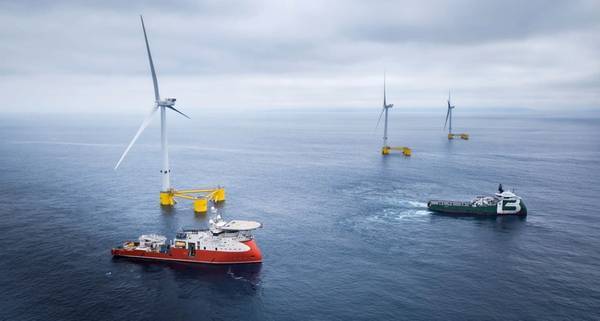
(Upstream) Five of seven lease auctions planned by the US Bureau of Ocean Energy Management up to the end of the 2025 are expected to have opportunities for floating wind.
Representatives of major offshore wind developers said that 80% of offshore wind potential is in the floating wind sector at the Floating Wind Solutions Conference on Tuesday in Houston.
The sector is relatively new compared to traditional onshore and offshore wind.
The Hywind Scotland project, launched in 2017, was the first commercial floating wind farm in operation, and just two other commercial projects have come online since.
Opportunities for US offshore wind are growing, with six blocks recently auctioned from the New York Bight.
California has a lease auction coming up later this year, with auctions in Oregon and the Central Atlantic next year, and in the Gulf of Maine in 2024.
Vincent Fromont, president of Shell-EOLFI and general manager of Floating Offshore at Shell Global Renewable Solutions, said floating wind will scale up exponentially as it grows, but for now, the supply chain is ill-prepared to handle the upcoming demand.
“Are we ready right now? No. The industry is not ready, the supply chain is not ready yet. A lot needs to happen, a lot needs some support from government regulators, building volumes, and building new capability globally,” Fromont said.
As developers begin to scale up floating wind technology, they are working on bringing down its levelised cost of electricity (LCOE), which sits at about €130 ($144) or €150 per megawatt-hour, depending on the project.
Aker Offshore Wind is using its project off Ulsan, South Korea, to bring the LCOE down to €50 per MWh by 2030.
“It’s not a choice at this point. We have to develop floating wind, it has to be cost effective, it’s a technology we have to exploit,” Aker Offshore Wind’s senior vice president of US operations Jonah Margulis said.
“We’re going to take steps in South Korea that we can’t elsewhere. We’re going to learn a lot, and we’re going to drive down LCOE to below €100 in a short amount of time.”
DNV forecasts the LCOE of floating wind to reduce by 80% by 2050 and capacity to increase 2000-fold.
Gulf of Mexico promise
Although California is likely to be the second play for US offshore wind, the Gulf of Mexico is a hot topic given its level of existing oil and gas infrastructure, which can be leveraged for offshore, especially for floating wind projects.
With California’s lease auction coming up, however, stakeholders in attendance were encouraged to not wait for wind activity to begin in the Gulf of Mexico before scaling up the supply chain.
“The markets on the West Coast and East Coast are there now,” said Chris Willow, head of floating wind development at German energy company RWE. “Build up your experience there, and then, when the Gulf of Mexico activities happen, you’ll be ready and able to compete for that activity.”
Willow believes wind developments in the Gulf Coast region are likely to be bottom-fixed, and hold the potential to cleanly power oil and gas operations.
So far, new offshore wind projects in US waters are dominated by European players, including oil and gas majors.
US supermajors have been clear in their focus on energy-transition technologies more directly related to their oil and gas assets, such as carbon capture, hydrogen and biofuels, but according to Orsted’s head of innovation and digital, Jacob Edmonds, this could be an issue for the Gulf.
“If we truly want to electrify the oil and gas platforms and the infrastructure that is in the US Gulf of Mexico, then we probably need one or two oil majors from the American side to truly step into this,” Edmonds said.


Leave a Reply