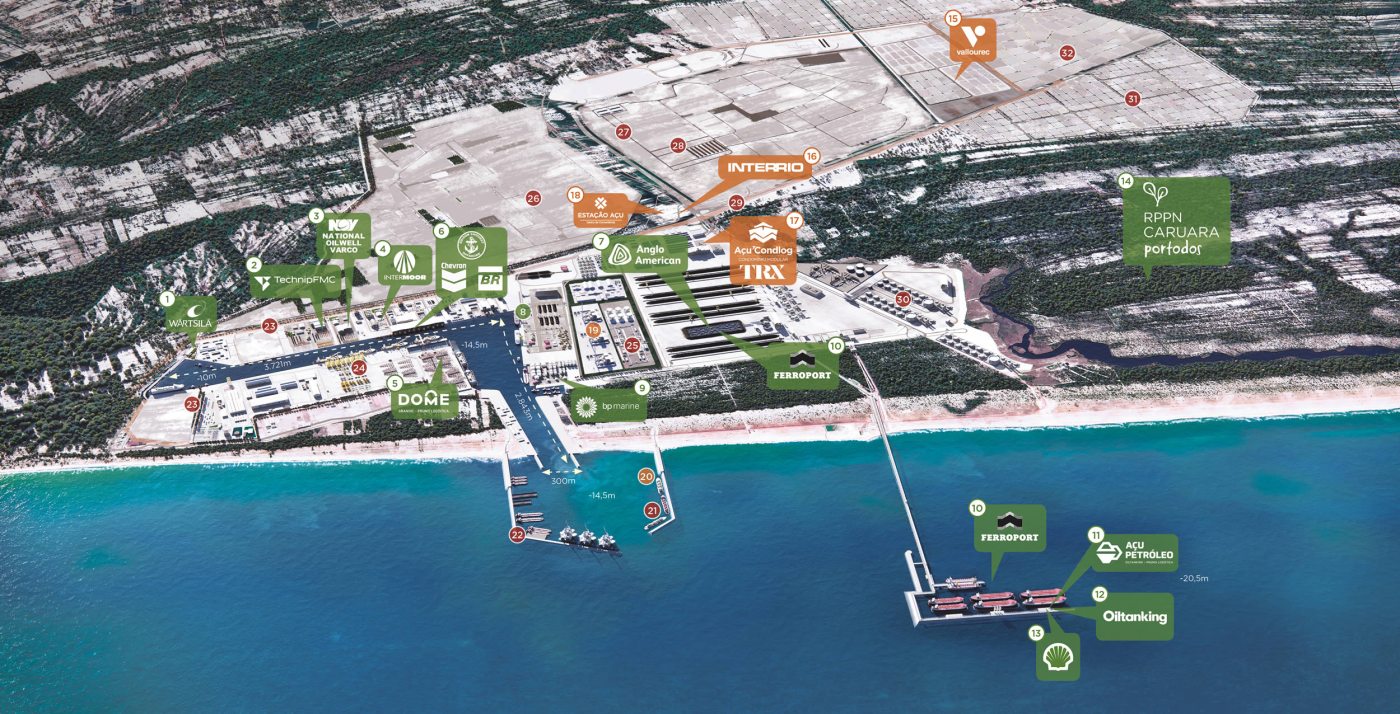
(TN) Porto do Açu and Gás Natural Açu (GNA) announced the realization of R$ 6 billion of investments in infrastructure and energy in Porto do Açu, located in the northern region of Rio de Janeiro.
Investments include works to expand road access to the port, the construction of a rail branch and the laying of the cornerstone of UTE GNA II, officializing the start of work on the largest natural gas plant in Brazil, with 1,673 MW.
The works to expand road access to Porto do Açu are part of the Pacto RJ, a package of investments in infrastructure launched by the Government of the State of Rio. As part of the technical cooperation agreement signed between Porto do Açu and the State Department of Roads and Highways (DER/RJ), the CEO of Porto do Açu delivered the technical engineering studies necessary for the bidding of the works, budgeted at R$ 396 million. The expansion of road access is essential given the strategic relevance of the port’s operations for several key sectors of the Brazilian economy, and given the project’s growth projections in the coming years. The expansion of the roads will also have a positive impact on reducing traffic in urban areas, on road safety and on improving the flow of local production.
Another milestone is the signing of the railway authorization contract between the Ministry of Infrastructure and Porto do Açu, which formalized the first private authorization for the construction of a railway in the State of Rio de Janeiro, and the first project in Rio de Janeiro included in the Pro Rails Program of the Ministry of Infrastructure. Corresponds to investments of R$ 610 million for the construction of the 41 km stretch connecting the Porto Açu terminals to the main branch of the railroad that will interconnect the Norte Fluminense region to the national rail network.
“The strategic geographic location of Porto do Açu, close to the offshore basins of Campos and Santos, the predominant area of occurrence of the Pre-Salt producing fields, made the port a strategic location for logistical support for offshore platforms. The expansion of road accesses will allow the growth of cargo movement to occur in a sustainable way, with greater road safety, in addition to facilitating the flow of local production. Regarding the railroad, studies indicate a potential flow of 16 million tons, of which 8 million tons are grains. These numbers indicate the additional potential for the Port to contribute to strategic sectors of the national economy, including agribusiness, and the enormous opportunity for industrial development from these investments”, projects José Firmo, CEO of Porto do Açu.
Also Gás Natural Açu (GNA) launched the Foundation Stone for UTE GNA II. With investments of more than R$ 5 billion, UTE GNA II will be the largest and most efficient natural gas power plant in the country. Its 1,673 MW are equivalent to 10% of all gas generation capacity available today in the National Interconnected System (SIN ) and guarantee the supply of 8 million homes.
The plant will operate in a combined cycle, which guarantees lower costs, lower emission intensity and greater energy efficiency, compared to the thermoelectric plants in operation. Furthermore UTE GNA II will use seawater, reinforcing GNA’s commitment to the rational use of water resources.
To make the plant’s implementation possible, GNA and the National Bank for Economic and Social Development (BNDES) signed a financing agreement in 2021 in the amount of R$3.93 billion.
“Today we officially celebrate the start of works on the UTE GNA II. A big step towards the consolidation of our gas generation park, the largest in Latin America. A structuring enterprise for the country that will generate thousands of jobs, bringing even more security and resilience to the electricity sector. We are grateful for the trust of our employees, shareholders, companies responsible for construction, financiers, as well as the support of regulatory and institutional bodies at the Federal, State and Municipal levels, which understand the importance of GNA as a vector for growth in the gas and energy for the country”, commented Bernardo Perseke, CEO of GNA.
The executive added that GNA is investing in infrastructure development to boost the gas and energy market, following the new regulatory framework. “We believe in the potential of natural gas in the context of energy transition and we want to go further, expanding access to fuel for industries and agents not connected to the pipeline network. With the railroad, we are studying to make gas more accessible for industries, and to take the LNG received by the GNA Terminal at Porto do Açu to the states of Minas Gerais and Espírito Santo and, possibly, to the Midwest”, he added.
UTE GNA II integrates the largest natural gas thermoelectric park in Latin America, with 3 GW of installed capacity, enough to supply energy to 14 million homes. The first plant, UTE GNA I, with 1,338 MW, started commercial operation in September last year and is generating safe and reliable energy for the country. The company also has 3.4 GW of licensed installed capacity, which will allow, in the near future, the expansion of the thermoelectric park to reach 6.4 GW.
To supply the plants, the GNA LNG Terminal is in operation, the first for private use in Brazil, where the FSRU BW MAGNA, a vessel capable of storing and re-gasifying up to 28 million m3 of gas per day, is moored. This volume is greater than the consumption needs of the thermoelectric park, which opens up new business opportunities from natural gas. The expansion plans include, in addition to the flow of gas via rail, the construction of onshore gas pipelines, integrating the Port of Açu with the pipeline network and a natural gas processing unit, both projects in the licensing phase.


Leave a Reply