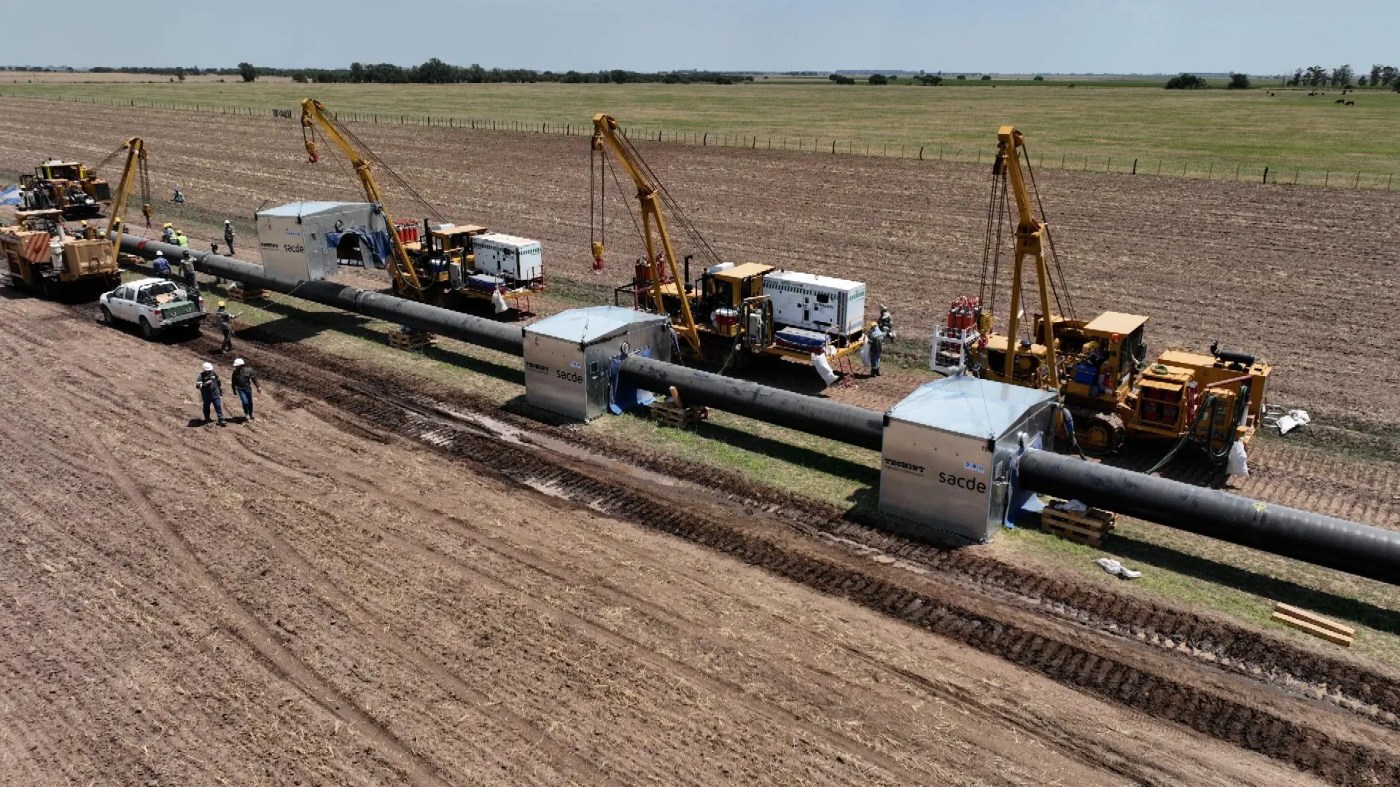
Nov 27 (Reuters) – A study backed by regional development bank CAF and the Latin American Energy Organization (OLACDE) on Friday identified 17 infrastructure projects worth $18 billion that would create an integrated natural gas and electricity market across six South American countries.
The plan, covering Mercosur trade bloc members Argentina, Brazil, Paraguay, and Uruguay, as well as Bolivia and Chile, aims to unlock up to $4.5 billion in net economic benefits for the region and create more than 200,000 jobs by 2035, according to findings presented in Montevideo.
- Gas interconnections carried 22 million cubic meters daily in 2025, 29% of their capacity
- The study evaluated 11 integration routes, 7 of which depend on Argentina’s Manuel Belgrano pipeline to move gas from the country’s Vaca Muerta shale formation
- The route to central Chile offered the highest cost savings relative to required investment compared with importing liquefied natural gas (LNG), the study found
- The Argentina-Brazil pipeline corridor via Bolivia offers the largest potential impact, the study added, though its competitiveness hinges on Argentine export duties, Bolivian transit fees, and Brazilian transport tariffs
- Under a limited-budget scenario, upgrading Argentina’s Northern Gas Pipeline would require $2.4 billion in additional investment to yield $4.3 billion in net regional benefits
- The study recommended advancing via pipelines, so countries can sign long-term stable contracts while negotiating a regional framework treaty


Leave a Reply