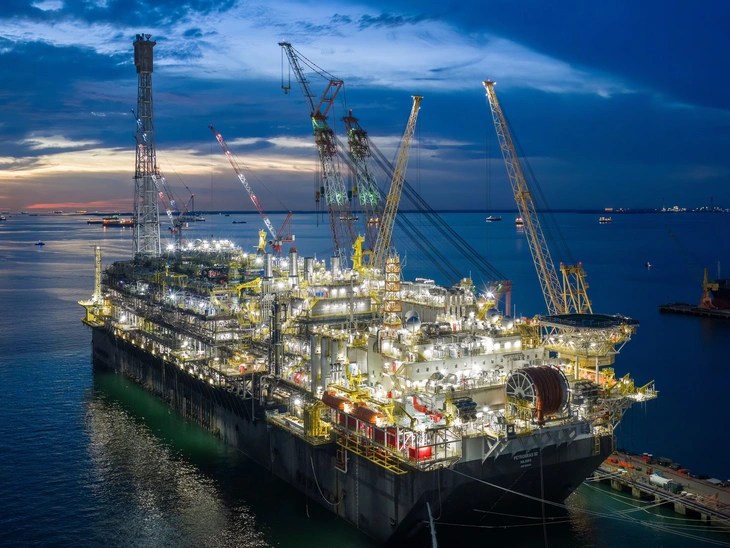
Oct. 20 (TN) On October 18, the FPSO P-82 departed from the Tuas Boulevard Yard in Singapore, bound for the Búzios field in the pre-salt region of the Santos Basin—the field with the largest reserves and production volume in Brazil. The P-82 is one of six giant FPSOs commissioned by Petrobras; with a nominal production capacity of 225,000 barrels per day (bpd) and the ability to compress 12 million cubic meters of gas, these units rank among the largest in the global industry.
This unit is the second to head toward the Búzios field in less than a month and is expected to begin operations next year. Like the P-80—which set sail for Brazil on September 30—the unit measures 345.3 meters in length, 60 meters in width, and weighs over 100,000 tons. The other platforms in the “80 series”—the P-83, P-84, and P-85—are destined for the Búzios, Atapu, and Sépia fields, all located in the pre-salt area of the Santos Basin.
“Even with our global reputation for developing and delivering large-scale platforms to operate in Brazilian deep waters, Petrobras is always focused on improvements. This includes ongoing dialogue with shipyards and various suppliers, as well as the incorporation of lessons learned and new innovations,” notes Renata Baruzzi, Director of Engineering, Technology, and Innovation at Petrobras.
What are the advantages
The 80 series boasts the highest production capacity among all platforms owned by Petrobras. These new units incorporate insights gained from previous construction projects and feature advanced technologies and digital solutions that ensure greater operational and energy efficiency. Why serial production?
Building platforms in series reduces costs and boosts productivity at shipyards, while also enhancing system reliability, lowering project risk, and accelerating field development. Another strategy being employed involves having the platform arrive at its designated offshore location with its crew already on board, which helps ensure the systems are operationally ready.
Some of the process modules for the P-82 platform were manufactured in Brazil at the Seatrium Aracruz shipyard in Espírito Santo—a process that helped qualify the local workforce, create jobs and income, and foster the development of the country’s shipbuilding industry. Other modules were built in Singapore and China, then transported to the shipyard in Singapore for final assembly and completion.
How the contract was structured
Petrobras contracted the construction of these platforms using the EPC (Engineering, Procurement, Construction, and Commissioning) model, under which the contractor is responsible for the engineering, procurement, construction, and commissioning of the unit, up until its delivery for operation in Brazil.
Petrobras has earmarked US$109 billion in investments for the 2026–2030 period, with 75% of that total allocated to Exploration & Production activities.
The Búzios field is operated by Petrobras, in partnership with CNOOC, CNPC, and Pré-Sal Petróleo S.A. (PPSA). It is projected that 11 platforms will be in operation at the field by the end of 2027.
See the projected start-of-production dates for these platforms, according to the 2026–2030 Strategic Plan.


Leave a Reply