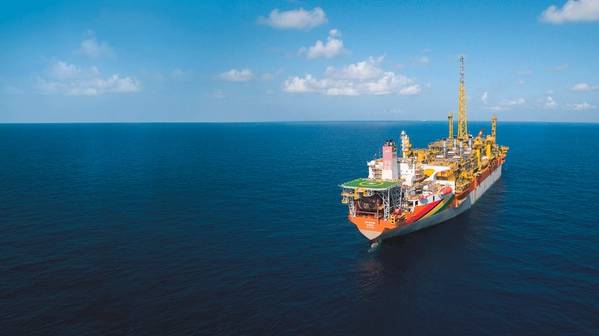
Aug. 12 (oilnow.gy) Guyana’s Hammerhead development, the country’s seventh sanctioned offshore oil project, is expected to begin production in 2029 with capacity of about 150,000 barrels of oil per day (b/d).
Its associated gas could first fuel Hammerhead’s own operations, with remaining volumes potentially sent through the Gas-to-Energy (GtE) pipeline to shore, connected to future infrastructure serving Berbice, or transferred to the Unity FPSO to support Liza oil production.
But how does one gas stream serve three different purposes? ExxonMobil’s Environmental Impact Assessment (EIA) provides the answer: a 13-kilometer offshore export pipeline will connect Hammerhead to the Gas-to-Energy pipeline, giving the produced gas several routes.
The pipeline connection
According to the EIA, the offshore pipeline will run from Hammerhead’s project pipeline end termination (PLET) to a tie-in point on the Gas-to-Energy pipeline PLET. This connection will allow gas that is not needed for Hammerhead’s own operations to enter the wider gas transportation system.
The connection includes a pipeline isolation valve module with multiple valves and subsea controls linking the Hammerhead export line to the GtE pipeline. The controls can be operated from the Hammerhead FPSO through a dedicated umbilical, allowing the export pipeline to be isolated when needed.
The pipeline itself will be designed for the conditions it will face on the seabed, including waves, tides and ocean currents. ExxonMobil’s EIA says geotechnical and geophysical studies are being used to assess the seabed along the route, while a probabilistic seismic hazard assessment has been conducted to evaluate seismic risk.
The design will also account for stresses caused by movement and temperature changes, as well as potential buckling, fatigue and vibration. Pipeline sections that span gaps on the seabed will be designed to meet installation, testing and operating requirements.
Using the 13-kilometer pipeline to move the gas
The U.S oil major estimates Hammerhead could produce about 95 million standard cubic feet per day (mcf/d) of gas. Once production begins, the gas will first meet the fuel needs of the Essequibo 1899 FPSO and other production equipment. Gas not needed for those operations could then be directed to one of three destinations:
- Gas-to-Energy: The project has two phases. Phase one, which is under construction, will use about 50 million cubic feet of gas per day from Liza field offshore for power generation and natural gas liquid (NGL) production. Hammerhead is expected to supply the contemplated phase two, which could use about 75 million cubic feet per day, support a second 300-megawatt power plant and increase NGL production by up to 6,000 barrels per day. The government has received bids for the phase two facilities but has not selected a contractor.
- Berbice: ExxonMobil’s wider gas plans include a proposed pipeline connecting the GtE network to Berbice. The project could eventually allow Hammerhead gas to reach Region Six (East-Berbice Corentyne) for power generation and other gas-based industries, including fertilizer production and alumina processing.
- Liza production: The EIA also identifies the Unity FPSO as another possible destination. Hammerhead’s gas could be transferred offshore to support oil production from the Liza field rather than being sent to shore.
ExxonMobil operates the Block with a 45% interest, alongside Hess (owned by Chevron) with 30% and CNOOC with 25%.
By Trichell Sobers


Leave a Reply