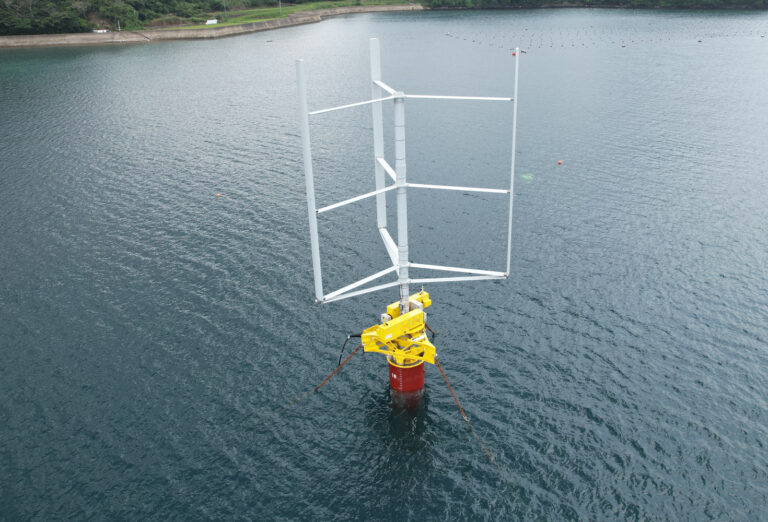
July 15 (offshoreWIND.biz) The Floating Axis Wind Turbine (FAWT) consortium of six Japanese companies has installed an experimental low-cost next-generation floating wind turbine in the bay of Iki City, Nagasaki Prefecture, Japan.
The concept aims to make a fully domestic supply chain of offshore wind possible. The demonstration has started as of July 2026 and will be carried out for one year.
The demonstrator consists of a vertical-axis wind turbine with three straight blades and a cylindrical floating foundation.
The diameter of the rotor is 9.3 metres, and the diameter of the floating foundation is 1.7 metres. The maximum output power is under 20 kW. Station-keeping is achieved by three mooring lines, each connected to seabed anchors.
The demonstration will verify the technical feasibility of FAWT, numerical analyses, and water tank test results. After the demonstration, the unit will be decommissioned, and detailed inspections of each component will be carried out. These activities are expected to help identify challenges for long-term operation and support the improvement of the design of future larger-scale systems.
To promote the development of offshore wind as a key renewable energy source, it is necessary to expand floating offshore wind power systems in Japan, where shallow-water sites suitable for bottom-fixed turbines are limited, the consortium said.
However, there are challenges in the adaptation of conventional horizontal-axis wind turbines to the floating system due to their large floating foundations and mooring systems required, which result in high costs.
To overcome these challenges, FAWT is based on a rational change of design philosophy derived from marine engineering principles. The goal of FAWT is to significantly reduce the cost of energy by simplifying the structure and lowering the center of gravity, while developing domestic supply chains for floating offshore wind.
Outcomes of the present demonstration, together with ongoing studies for larger-scale systems, will be used to advance the development of megawatt-class demonstration systems, with the ultimate goal of their commercial deployment in the future.
The FAWT consortium plans to leverage the expertise possessed by each participating company in the joint development of the FAWT, which has the potential to be a game changer for the floating offshore wind industry. Through this, the consortium aims to establish offshore wind as a primary source of electricity and contribute to the realization of the carbon-neutral society.
The FAWT consortium comprises Electric Power Development Co., Ltd.; Tokyo Electric Power Company Holdings, Inc.; Chubu Electric Power Co., Inc.; Kawasaki Kisen Kaisha, Ltd.; Sumitomo Heavy Industries, Ltd.; and Albatross Technology Inc.
 Brazil Energy Insight
Leave a comment