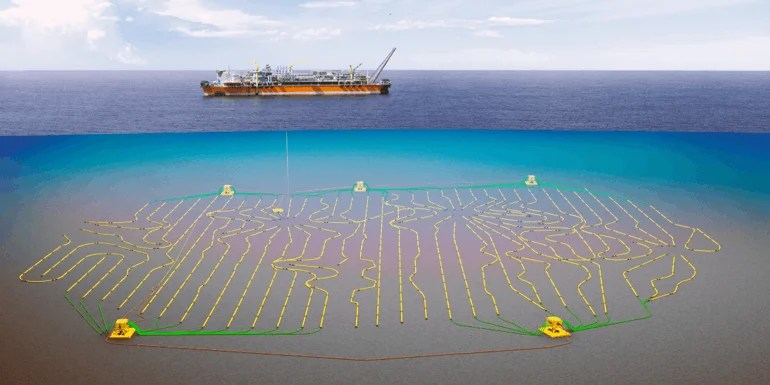
April 14 – The Mero field will be the site of the world’s most extensive seismic monitoring project, with an investment of US$450 million. This unprecedented project in deep waters will reveal data that will allow for a deeper understanding of the reservoir’s behavior and its dynamics over time. The investment will be led by Petrobras, the field’s operator, along with its partners in the asset — Shell, TotalEnergies, CNPC, CNOOC, and PPSA.
The first phase of the monitoring program, with the installation of more than 460 km of cables with optical sensors, covering an area of 222 km², was completed in March of this year. The installed infrastructure will be responsible for monitoring oil and gas production activities on the FPSOs Guanabara (Mero 1) and Sepetiba (Mero 2), and the first data will be collected in the second quarter of 2026.
Currently, computers on board the platforms receive the data collected from the seabed, but in the future, the data will be sent, via fiber optics, to the company’s headquarters.
The second phase is also underway with the construction of an additional 316 km of seismographic cables, which will cover another 140 km² of the production areas of the FPSOs Duque de Caxias (Mero 3) and Alexandre de Gusmão (Mero 4). This stage will be completed next year.
The installation of a permanent network of seismic sensors installed on the seabed is known as PRM, an acronym for Permanent Reservoir Monitoring System. By optimizing field management, the technology maximizes oil production without a significant increase in emissions, thus contributing to a reduction in the carbon footprint.


Leave a Reply