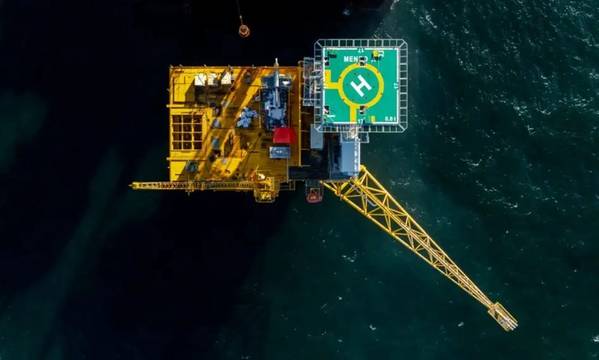
April 9 (Reuters) – Energy producer Shell plans to begin natural gas output in 2027 from the Loran-Manatee offshore field, which crosses the border of Venezuela and Trinidad and Tobago the chairman of Trinidad’s National Gas Company, Gerald Ramdeen, told Reuters on Thursday.
Shell is moving to accelerate gas projects in Venezuela under interim President Delcy Rodriguez’s administration, particularly those with Trinidad, which needs fresh gas supplies to feed liquefied natural gas and petrochemical projects.
Shell told NGC it was working to have first gas from the joint field next year. It has increased the capacity of the pipeline that will transport the gas to Trinidad to 1 billion cubic feet per day, from the 700 million cubic feet per day originally planned, NGC’s chairman said.
“That gas will now be brought to our Beachfield facility via a 32-inch pipeline, rather than the original 24-inch pipeline,” Ramdeen added in an interview.
Reuters previously reported that Shell was in advanced discussions to participate in Loran, the Venezuelan side of the field, and could choose to develop it as a unified project alongside Manatee, whose planning on Trinidad’s side has progressed in recent years.
Shell said in an email to Reuters that it expects to begin production at Manatee next year, but it has not taken any final investment decision on Loran.
Loran holds 7.3 trillion cubic feet of gas reserves, while Manatee has estimated reserves of 2.7 TCF. Loran was explored by U.S. producer Chevron under a Venezuela contract for two blocks of the Plataforma Deltana offshore gas project, which remains inactive. Chevron is now relinquishing the field, while negotiating a new oil block at Venezuela’s Orinoco Belt.
FRESH TALKS
Trinidad and Tobago’s Cabinet is expected to decide on Thursday which officials will form a negotiating team for talks with Venezuela over a separate 4.5-TCF gas field also to be operated by Shell and in which state-run NGC also has a stake.
The Dragon project lies entirely in Venezuela waters. Shell holds 80% of the project and NGC the remaining 20%, according to a 30-year license granted by Venezuela in late 2023.
Relations between Venezuela and Trinidad have deteriorated since the election of a new government in Trinidad. Venezuela last year declared Trinidad’s Prime Minister Kamla Persad‑Bissessar persona non grata.
On Wednesday, Persad‑Bissessar said a Trinidadian delegation would travel to Caracas to meet with Venezuelan officials on the Dragon project.
Ramdeen said the prospect of additional gas supplies, combined with geopolitical concerns stemming from the U.S.-Israel war on Iran, had prompted NGC to push for the restart of the first liquefaction train of the Atlantic LNG project, which was mothballed years ago due to a shortage of gas.
“We have told the partners that we think there is a need to restart Train 1 because of the geopolitical uncertainty and access to additional gas,” Ramdeen said, adding that a final decision has not been made.
Shell and BP each own 45% of the flagship LNG project, while NGC holds the remaining 10%.
BP did not immediately respond to a request for comment.
 Brazil Energy Insight
Leave a comment