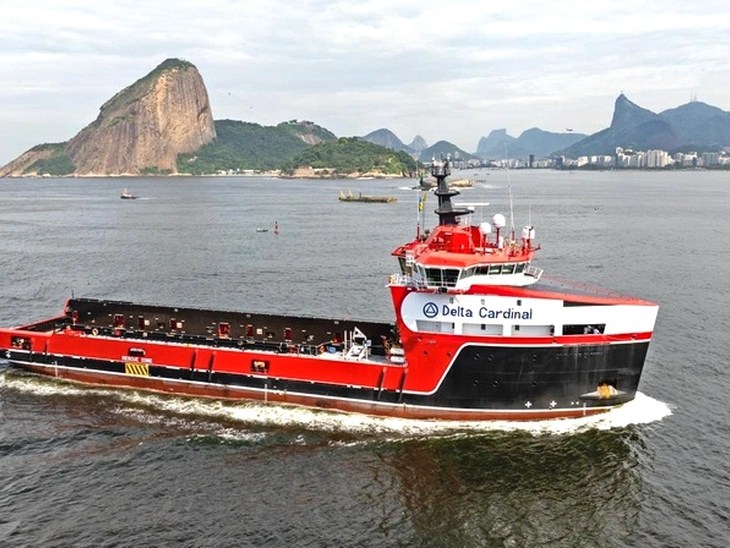
April 1 (PN) Brazilian demand for platform supply vessels (PSVs) peaked at 140 vessel-years in 2025, driven by new offshore developments and high daily rates. This data comes from a survey by Rystad Energy, authored by Supply Chain specialists Victor Claro and Einar Michel. According to the consultancy, this scenario led shipowners to mobilize foreign-flagged vessels to Brazil. However, the consultancy notes that the addition of vessels last year was lower than in previous years, signaling a possible stabilization of demand for high-specification vessels. For this year, the supply of PSVs in the Brazilian market is expected to decline slightly and remain stable until 2030, with more favorable prospects for shipowners with newer, high-specification units and a strong local presence, either through domestic fleets or partnerships.
According to Rystad’s calculations, Brazil recorded 69 PSV entries and 24 exits between 2021 and 2025 — a cumulative net increase of 45 vessels. Entry activity was particularly strong between 2022 and 2024, in line with robust demand growth of 10% per year. Last year marked a turning point, with net entries falling to six vessels, the lowest growth in the period. This coincided with the peak of PSV demand in Brazil, expected to fall to 132 vessel-years this year and stabilize in the second half of the decade. Even with the reduction, Brazil remains the third largest PSV market in the world, behind only the North Sea (167 vessel-years) and the Gulf of Mexico (152 vessel-years).
“The last five years of continuous supply growth have been associated with robust investments in offshore operations, especially in pre-salt fields, with 14 production, storage and offloading (FPSO) units commencing operations during this period. This growth also highlights the structural influence of Petrobras, responsible for approximately 80% of PSV market activity, meaning that the contracting decisions and project schedules of the country’s main operator directly impact fleet dynamics,” Rystad pointed out.
The company also indicated that demand has been growing among other operators in Brazil, expanding opportunities for shipowners. PRIO was the second largest PSV operator last year, with the integration of the Peregrino field, followed by Perenco’s revitalization efforts and Equinor’s logistics for the start of operations of the Bacalhau FPSO. At the same time, competition from neighboring markets, especially Guyana and Suriname, is offering alternative allocation options for high-specification vessels in South America.
The consultancy assesses that the stabilization of demand growth for PSVs in Brazil, combined with operators’ focus on cost efficiency, is creating a more challenging environment for shipowners seeking to allocate surplus tonnage from other regions in the country without pressuring current daily rates. As a gradual reduction in demand for PSVs is expected in most offshore basins, there are few evident alternative markets to which to direct vessels without firm contracts.
FOREIGN-FLAG VESSELS
Rystad’s analysis noted that foreign PSVs can be brought to Brazil to support offshore activities, but their participation in tenders has historically been more restricted than that of local vessels. In practice, foreign units face a greater risk of being replaced by Brazilian-flagged vessels during contracts, making direct entry less straightforward.
It turns out that the so-called Brazilian Special Registry (REB) has become an important mechanism for expanding fleet availability. In general, the REB allows companies with eligible Brazilian tonnage to bring foreign vessels to operate under the Brazilian flag, reducing some of the barriers traditionally associated with foreign entry.
“Operational data shows the growing role of foreign-flagged vessels. With increased demand, local units no longer meet all the required specifications, making it necessary to mobilize vessels from other markets. The activity of Brazilian-flagged vessels has been stable since 2023, while the arriving units have met the growing demand. In 2021, foreign vessels had practically no participation, but last year they came to represent about 20% of the market, coming from countries such as the United States, Norway, Mexico, Isle of Man, Liberia and the United Kingdom,” concluded Rystad.
 Brazil Energy Insight
Leave a comment