- Suriname is experiencing renewed optimism for its oil industry with the approval of the GranMorgu project and significant investment from international energy companies.
- The country hopes to leverage its offshore oil discoveries to address economic challenges and reduce poverty, drawing inspiration from neighboring Guyana’s successful oil boom.
- Several offshore blocks, including Block 58 and Block 52, show promise for substantial oil and gas production, with various companies actively exploring and developing these resources.
(oilprice.com) After ExxonMobil’s swathe of world-class discoveries in Guyana’s offshore Stabroek Block, the Guyana-Suriname Basin emerged as the world’s hottest drilling location. While Guyana’s economy is booming, becoming an oil superpower, neighboring Suriname has yet to benefit from the basin’s immense hydrocarbon potential, despite world-class oil discoveries in offshore Block 58. Suriname, a small country with a population of less than 700,000, which is among South America’s poorest, is believed to possess petroleum potential comparable to that of its neighbor. While the government in the capita,l Paramaribo, is hungrily eyeing Guyana’s success as the world’s newest petro-state, there are signs Suriname’s long-awaited oil boom will finally take off.
President Chan Santokhi’s administration pinned its hopes on an oil boom, similar to Guyana’s, beginning in 2025 with the development of Block 58, aiming to rescue Suriname from a deep economic crisis. This, Paramaribo hoped, would deliver wealth and urgently needed revenue, thereby alleviating the growing crisis sparked by a decade of fiscal mismanagement. Indeed, the situation was so dire that in November 2020, at the height of the COVID-19 pandemic, Suriname defaulted on its sovereign debt, and Paramaribo was forced to devalue the Surinamese dollar sharply. Those events intensified the economic catastrophe while forcing the government to restructure Suriname’s existing debt and seek additional international capital.
By February 2023, the financial crisis had become so dire that the IMF imposed austerity measures on the former Dutch colony. These, along with further devaluing the currency, were implemented by Santokhi’s administration in exchange for obtaining access to urgently needed loans. The harsh scheme was imposed on Paramaribo due to Suriname’s ballooning public debt, soaring inflation, and declining gross domestic product (GDP), which had plummeted by a whopping 51% over a decade to around $3.5 billion by 2023. Suriname’s economic catastrophe is rooted in the chronic malfeasance and corruption that prevailed during the 10-year tenure of President Santokhi’s predecessor, President Dési Bouterse, a convicted murderer linked to cocaine trafficking.
These arrangements, coupled with Paramaribo slashing spending, caused the cost of living to spiral higher in a country where nearly a fifth of the population lives in poverty. The fallout was severe, with unemployment, inflation, and poverty soaring due to the harsh economic austerity being implemented. This fomented considerable unrest among Suriname’s population, particularly as prices soared because of the sharp devaluation of the Suriname Dollar. These developments sparked mass anti-government protests with participants demanding the resignation of President Santokhi while riots broke out in the capital Paramaribo, with protestors storming Suriname’s parliament.
This intensified the government’s desire to kickstart the economy, especially after decades of financial neglect and witnessing the transformational riches generated by neighboring Guyana’s monumental oil boom. The considerable wealth created by the petroleum discovered in the Stabroek Block saw Guyana, last year, overtake Uruguay to become South America’s wealthiest country by GDP per capita. Indeed, Guyana’s 2024 GDP per capita soared by a stunning 41%, hitting a record $30,960, which is significantly higher than Uruguay’s $23,000 and more than four times greater than Suriname’s $7,600. Surprisingly, Guyana’s GDP per capita is also now higher than that of members of the European Union, including Portugal and Hungary.
The key issue weighing on Suriname’s much-needed oil boom is the considerable delay associated with developing offshore Block 58. TotalEnergies, the operator and 50% partner of APA Corporation, postponed development of the 1.4 million-acre block in 2022 due to concerns over reservoir quality and a high gas-to-oil ratio. This changed with the October 2024 approval of the GranMorgu project in Block 58’s southern zone, with TotalEnergies and APA announcing their $10.5 billion final investment decision (FID).
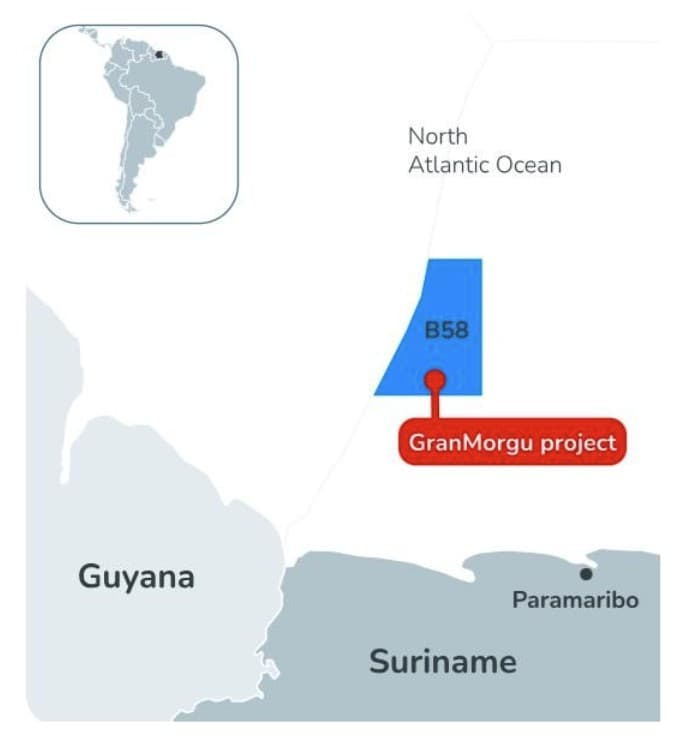
Source: TotalEnergies.
The GranMorgu facility, with a planned nameplate capacity of 220,000 barrels per day, is targeting a 760-million-barrel resource identified by the Sapakara and Krabdagu oil discoveries.
Read full article: https://oilprice.com/Energy/Energy-General/Surinames-Oil-Industry-Poised-for-Significant-Growth.html
 Brazil Energy Insight
Leave a comment