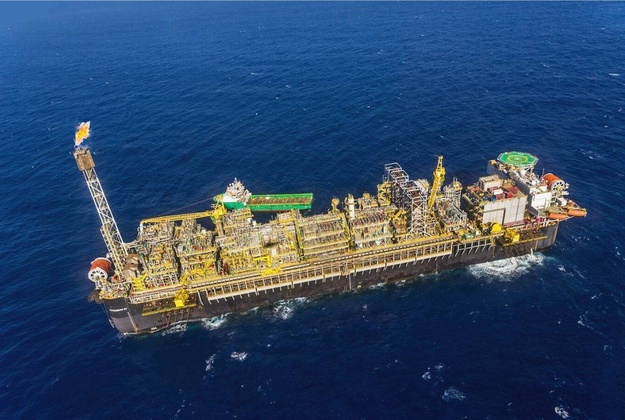
As part of the commitment to identify, measure and reduce methane emissions linked to their activities, TotalEnergies and Petrobras began a collaboration to carry out an evaluation campaign using drone methane measurement technology on FPSO P-70, dedicated to production from the Atapu field, located in the Santos basin in Brazil.
In 2022, TotalEnergies set ambitious targets to reduce methane emissions from its operations by 50% by 2025 and 80% by 2030, compared to 2020 levels, and implemented a global campaign to measure methane emissions from of its activities in all oil and gas installations operated by the Company – including the Lapa field, in the Santos basin, in Brazil – with AUSEA drone technology.
In collaboration with its strategic partner Petrobras, TotalEnergies is now extending this initiative to other fields in Brazil.
Petrobras reinforced its sustainability commitments, through its Climate Notebook, in 2023. These commitments are focused on mitigating climate change and combined with the ambition to neutralize its net operational greenhouse gas (GHG) emissions by 2050.
This movement is in line with several initiatives in the Oil and Gas sector, such as the Near Zero Methane Ambition and the global flaring monitoring panel, from the Oil and Gas Climate Initiative (OGCI) and the World Bank’s Zero Routine Flaring initiative, from of which TotalEnergies and Petrobras are signatories.
Leading the industry through OGMP 2.0
TotalEnergies and Petrobras joined OGMP 2.0, an initiative coordinated by the United Nations Environment Program (UNEP), created in 2020 to guide reports regarding methane emissions in the oil and gas sector. This initiative motivates companies to seek continuous improvement in the provision of emissions data from their operated and non-operated assets, in addition to providing for on-site measurements to verify that the reports are exhaustive and accurate.
With this drone measurement campaign, TotalEnergies and Petrobras are taking concrete steps to implement best practices to reduce greenhouse gas emissions, especially methane and aiming for zero methane emissions by 2030.
“In Brazil, we were pioneers in carrying out this campaign in our Lapa field, which represents our dedication to reducing emissions in our operations, contributing to the company’s ambition to reach Net Zero by 2050, together with society. Now, we will start this campaign with Petrobras, one of our main partners, to support their efforts against methane emissions in joint assets, operated by Petrobras. We believe that our industry should have the collective ambition to work towards the goal of zero emissions of methane.”, said Charles Fernandes, General Director of TotalEnergies EP Brasil and Country Chair.
Another step in the strategic alliance
TotalEnergies and Petrobras are partners in Brazil in the development of important pre-salt offshore assets, such as Mero, Berbigão, Sururu, Atapu and Sépia. The companies have a strategic multi-energy agreement on Research and Development, in force since 2017. This new collaboration is further proof of the valuable cooperation between the two companies on important topics such as reducing greenhouse gas emissions.
About AUSEA (Airborne Ultralight Spectrometer for Environmental Applications) – AUSEA consists of a miniature dual sensor mounted on a drone, capable of detecting methane and carbon dioxide emissions, while also identifying their source. This technology was developed by TotalEnergies, the French National Center for Scientific Research and the University of Reims Champagne Ardenne and is currently considered the most accurate technology in the world for detecting and measuring methane emissions.
 Brazil Energy Insight
Leave a comment