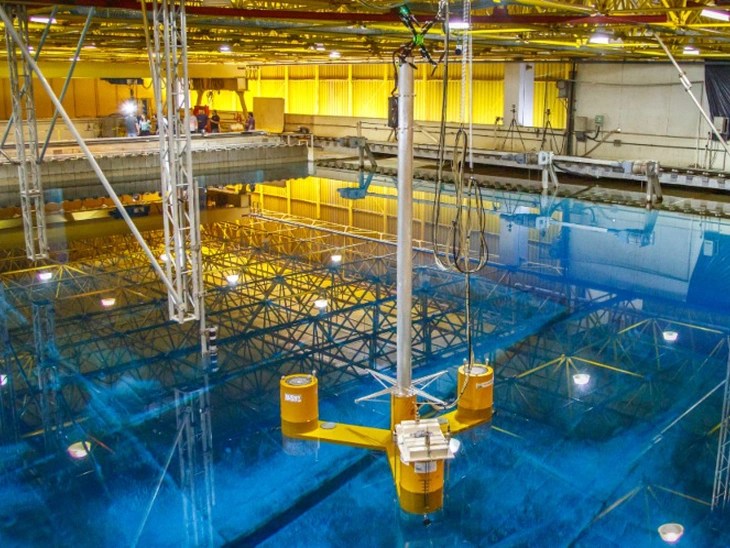
(PN) Petrobras conducted performance tests of an innovative model of offshore wind technology, a pioneer in Brazil, in collaboration with the Polytechnic School of USP. The tests aimed to evaluate the functioning of a small-scale floating wind system, composed of a wind turbine mounted on a four-column semi-submersible structure. This configuration was positioned in the test tank at the Laboratory of Ocean Technology at COPPE/UFRJ. The simulated environment reproduced the typical environmental and maritime characteristics of the pre-salt region in the Santos Basin, where this technology could be implemented at a later stage, if its technical and economic viability is proven. The test evaluated the response of the floating wind generation system to the adverse environmental conditions of the pre-salt layer, located at depths greater than 2,000 meters.
On a full scale, each floating system will have a capacity of up to 15 MW, representing between 10% and 30% of the electricity needed to power a pre-salt exploration platform. In an offshore application, the researchers are examining the possibility of connecting the wind generation unit to the platform or to a subsea system, located in deep waters. This link would be established through an electrical cable known as an “electric umbilical”, with the purpose of providing low-carbon energy for oil and gas production assets.
“We joined forces with USP and UFRJ, two of the most important Brazilian universities, to test a 100% national technology, offshore wind, capable of reducing emissions on our pre-salt platforms. This project demonstrates the importance of partnerships between Petrobras and the academy to boost the energy transition movement in the country, with great potential to trigger an unprecedented wave of innovation in Brazil”, said the president of Petrobras, Jean Paul Prates.
The company’s Director of Engineering, Technology and Innovation, Carlos Travassos, said that with the results of the tests, Petrobras will compare this initiative with other options for decarbonizing exploration and production operations, with regard to the energy supply of the platforms. . “We will consider the best alternatives in terms of costs to meet our decarbonization targets within the most rigorous technical, environmental and safety conditions”, he explained.
Offshore wind is one of Petrobras’ bets to develop low-carbon solutions in the horizon of its Strategic Planning. “This project demonstrates how the issue of energy transition cuts across Petrobras and is among its priorities. This is an initiative that involves our Research and Development Center Leopoldo Américo Miguez de Mello (Cenpes) and our Exploration and Production area, in our main production environment, the pre-salt, which will provide relevant information for the evaluation opportunities in offshore wind”, said Petrobras Energy Transition director, Maurício Tolmasquim.
 Brazil Energy Insight
Leave a comment