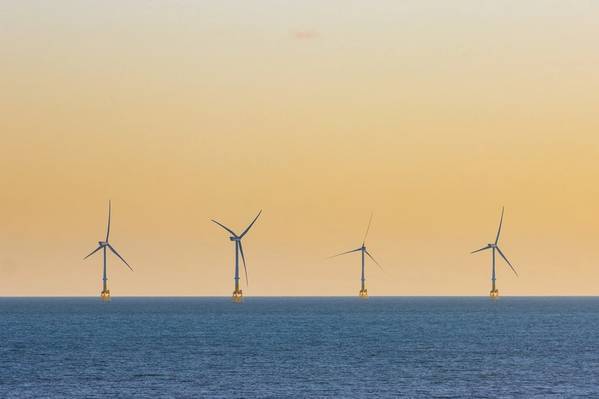
(Valor) Until the month of April, the Brazilian Institute for the Environment and Renewable Natural Resources (Ibama) received requests for environmental licensing for 54 projects for offshore wind power generation, with a total capacity of 133.3 gigawatts (GW) of power. The total energy to be generated in the projects corresponds to almost 70% of the current generation capacity of the entire national electric system, which is 200 GW. Of this amount, 84% come from renewable sources, according to Eduardo Raffaini, leading partner in the oil and gas, chemical and industrial sectors at Deloitte.
However, offshore generation has the potential to reach 967 GW in places where water depth is up to 50 meters, wind speeds reach seven meters per second and wind turbine towers are at a height of 100 meters, reports Raffaini, citing studies by the Energy Research Company (EPE). Among the projects submitted to IBAMA for consideration are those of Ocean Winds, a joint venture between Engie Brasil and EDP Renováveis. The company has expressed interest in building five offshore wind farms with 15 GW of capacity in Piauí, Rio Grande do Norte and Rio Grande do Sul.
The projects are in their initial phase and, therefore, it is not possible to estimate the volume of investment required for their implementation. “It will still take some time for the supply chain of goods and services to prepare to operate in Brazil”, explains Gil Maranhão Neto, director of communication and corporate social responsibility at Engie Brasil.
The potential for wind generation off the Brazilian coast has also attracted large companies in the oil and gas sector, many of them with expertise in the development of offshore projects abroad. This is the case of Equinor Brasil Energia, headquartered in Norway and operating locally for approximately 20 years.
The company informs that it seeks authorization for wind farms that add up to 14.5 GW of installed power. In addition to projects in Rio de Janeiro and Espírito Santo (4 GW), it is “evaluating another five projects in Ceará, Piauí, Rio Grande do Norte and Rio Grande do Sul, which would have an installed capacity of 10.5 GW”.
Most of the licensing requests were submitted from January onwards, when Decree 10,946 was published with the general guidelines for the assignment of use of areas destined for offshore wind generation. The Ministry of Mines and Energy has until the end of the year to issue an ordinance regulating, among other points, the criteria that will guide this process. According to Ana Karina Souza, energy partner at Machado Meyer Advogados, there is an expectation that a public consultation will be held so that suggestions can be added to the draft ordinance. “It is important that there is an open and transparent debate to align the rules”, she highlights.
Once the regulation stage is completed, the projects can be licensed by Ibama. It is estimated that the first offshore wind farms will start operating before 2030. To unlock the offshore sector, it will also be necessary to bid for the areas for the development of projects and, later, to carry out energy purchase auctions in the regulated market.
The Ten Year Energy Expansion Plan 2030 prepared by Empresa de Pesquisa Energétiica (EPE) included offshore wind technology as one of the generation sources. The projection is to add 56 GW of installed power to the national electricity system by the end of the decade. Of this total, 17 GW come from plants that operate on land and at sea.
 Brazil Energy Insight
Leave a comment