
Brazilian Economy Struggles to Take Off
Business faces fraught time amid drought, a sluggish economy and a corruption scandal
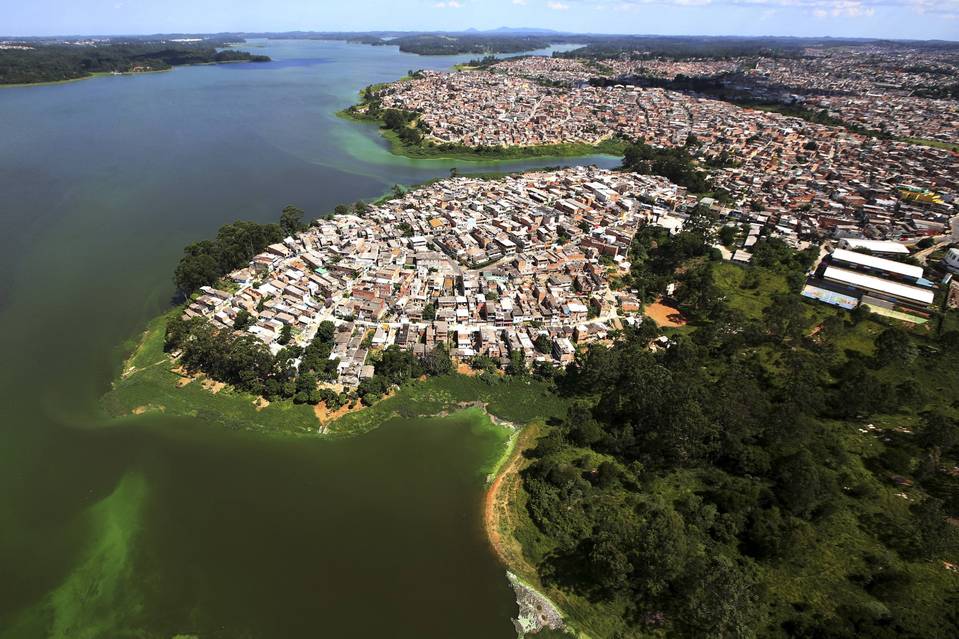
Economists expect Brazil’s gross domestic product to contract 1.18% this year and growth of just 1% in 2016. PHOTO: PAULO WHITAKER/REUTERS
By
LORETTA CHAO and ROGERIO JELMAYER/WSJ
May 4, 2015 10:45 p.m. ET
SAO PAULO, Brazil—With Brazil dogged by drought, a sluggish economy and a corruption scandal at its most important company, businesses in Latin America’s largest economy have little to be optimistic about.
Economists expect Brazil’s gross domestic product to contract 1.18% this year and growth of just 1% in 2016. Federal prosecutors are in the midst of an investigation involving hundreds of millions of dollars allegedly skimmed from Brazil’s state-run oil giant, Petroleo Brasileiro SA, by the country’s top construction companies. A multiyear drought is threatening water supplies in São Paulo state, which accounts for 40% of Brazil’s industrial production.
All that makes this a fraught time for business in Brazil, which, fueled by a commodities boom, reached 7.6% economic growth in 2010 but has been slowing ever since. Amid bad news and uncertainty, the hope that the country would become an economic superpower has fizzled. Executives and investors say sentiment about Brazilian business inside and outside the country is the lowest it has been in years.
“Brazil’s economy has been like a chicken trying to fly. It takes off, then it falls,” saidBruno Caetano, senior director of the small business association Sebrae in São Paulo. Profits for small businesses decreased between 2013 and 2014 because of high taxes and high interest rates, and many Brazilian manufacturers have taken to opening factories in China or becoming importers, he said.
Carlos Tilkian, chief executive of Brazil’s biggest toy maker, Manufatura de Brinquedos Estrela SA, is one such businessman. High costs in Brazil pushed him to outsource manufacturing to China, and 35% of his sales are now outside Brazil, including some in Turkey and Russia. He says the move has helped cushion his company from rising energy costs at home, though Brazil’s weakening currency has offset some of his savings from importing from China. The real has dropped more than 13% against the dollar since the beginning of the year.
With the economy shrinking, weak consumption and the country polarized over politics, “we have a scenario of uncertainty,” Mr. Tilkian said. “My biggest concern is the political situation, which can bring bigger difficulties and make consumers more cautious.”
The uncertainty is already bubbling to the surface. In recent weeks, Brazilians have taken to the streets to protest what many view as widespread corruption and economic mismanagement by President Dilma Rousseff.
Axel Christensen, managing director and chief investment strategist for Latin America at BlackRock, said he traveled to Brazil recently and “was only able to find two groups of investors: the pessimistic and the very pessimistic.”
But the weaker real could be an opportunity for some, including export-oriented Brazilian companies, Mr. Christensen said. “We’re not going to see [the] commodities super-cycle that we saw in prior years, but Brazil has companies and sectors that are more in the value-added space in terms of export.”
Meanwhile, many companies remain bullish about the country’s long-term prospects. Coca-Cola FEMSA, for example, a franchise bottler for the beverage company in Latin America, announced this month it would boost its usual investment in Brazil by 50% to $852 million, with plans to open three new bottling plants in the country despite economic concerns.
Cassia Carvalho, executive director of the Brazil-U.S. Business Council, said the problems are a concern for the council’s 110 member companies, which have collectively invested hundreds of billions of dollars in Brazil. But “the Brazilian government is taking the necessary steps to bring back equilibrium and growth,” she said. “Brazil continues to be a serious market and interesting market for U.S. investors. There is absolutely no scaling back.”
Still, the recent woes add to the already high costs of doing business in Brazil. The water shortage in São Paulo, for example, has forced electricity generators to rely more heavily on thermal power to conserve water in the nation’s hydroelectric reservoirs, which generate about two-thirds of Brazil’s electricity. To pay for it, utilities recently increased rates nearly 30% in some areas. Companies say they are already feeling the effects.
Luis Curi, vice president in Brazil of Chinese auto maker Chery Automobile Co., said the company’s energy bills rose 21% between 2009 and 2014, even before the latest rate increases kicked in.
“The energy issue is a concern because energy is important in our cost structure, and we are already feeling the rising costs,” Mr. Curi said.
The company recently completed construction of two plants in São Paulo for $530 million. “Our project was totally planned with a base cost estimate for the first year of operations, and we will have much higher energy costs than projected,” the executive said. “It’s making me lose sleep.”
“Four years ago, Brazil was the flavor of the month for investors, and everyone thought that Brazil would change from ‘country of the future’ to the ‘country of the present,’ but it didn’t happen,” Mr. Curi added. “This generated a huge frustration.”
Marcelo Haddad, executive director of Rio Negocios, a government-backed agency created to help bring investment into Rio de Janeiro, said he hopes the Olympics will show the world that, despite recent problems, Brazil is an important market that isn’t any more difficult than other emerging markets, such as India.
“These are not necessarily euphoric times,” he added, “but it’s a time to have a more long-term vision about how to invest in a country like Brazil, where the business environment is a little bit harder.”
—Luciana Magalhaes contributed to this article.
Write to Loretta Chao at loretta.chao@wsj.com and Rogerio Jelmayer atrogerio.jelmayer@wsj.com


Leave a Reply