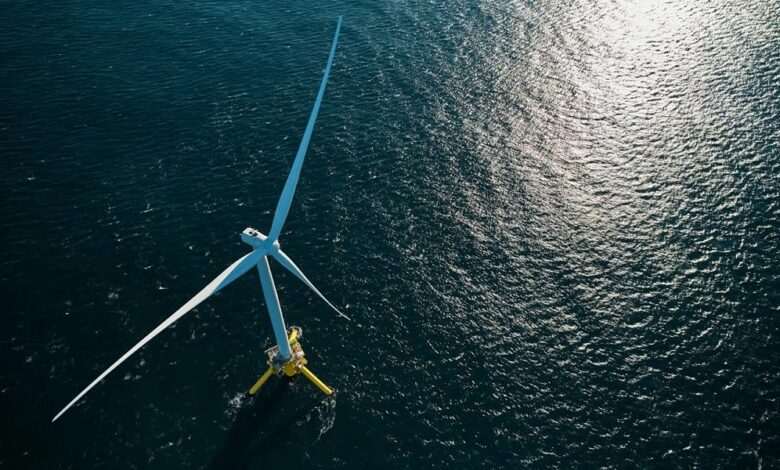
Nov. 3 (splash247.com) Norwegian floater specialist BW Offshore is planning to deploy two of the world’s largest floating wind turbines on its BW Ideol foundations after its Fram Wind Solutions joint venture secured NOK1.94bn ($210m) in state funding support.
The 37 MW project will feature two 18.5MW turbines installed on BW Ideol’s patented Damping Pool floating foundations at the METCentre offshore wind demonstration site off Karmøy.
Fram Wind Solutions is owned by BW Offshore with a 50% stake, Grieg Kapital with 35% and Fram Green Technology with the remaining 15%.
The funding, awarded by Norwegian state agency Enova, remains conditional on the project reaching a final investment decision, securing financing and signing agreements with key suppliers within 24 months of the award. The developers aim to install the turbines within the next five years.
“The Enova grant is a strong endorsement of our floating wind solution. It will enable us to deploy BW Ideol’s technology on the next generation of turbines and move floating offshore wind to commercial scale,” said BW Offshore chief executive Marco Beenen.
The project will test whether the Damping Pool foundation design can support increasingly powerful turbines while reducing the costs of floating wind construction, installation and operation.
BW Ideol’s technology is already being used at the 30MW EolMed floating wind farm off the French Mediterranean coast. The development, comprising three 10MW turbines, first supplied electricity to the grid in April 2026 and reached full capacity in May.
BW Offshore owns 68% of BW Ideol, which has also deployed its floating technology at demonstration projects off France and Japan.
As Splash previously reported, Enova allocated a combined NOK3.94bn ($430m) to two floating wind developments at METCentre.
The other recipient, Fortius Offshore Wind, backed by Deep Wind Offshore, received NOK2bn to install two more 18.5MW turbines.
Together, the projects will add 74MW of floating wind capacity, with expected annual generation of approximately 300GWh, equivalent to the electricity consumption of around 15,000 households.


Leave a Reply