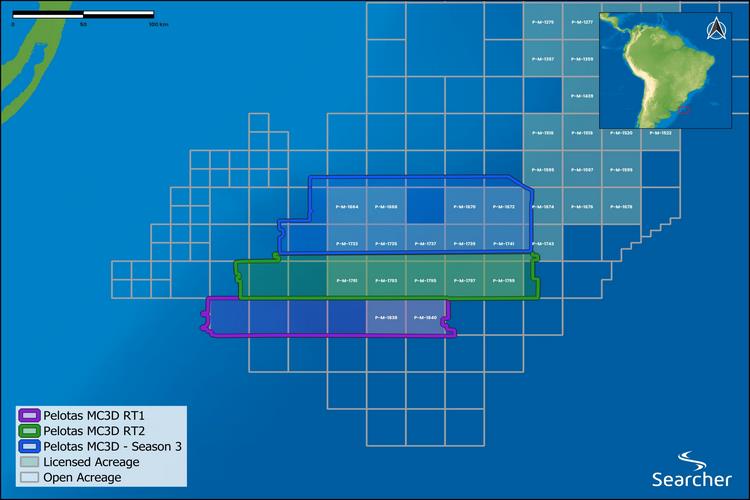
Sept. 30 (PN) The Pelotas Basin, located in the Brazilian southern region, may hold approximately 1 trillion cubic meters of recoverable natural gas, according to a preliminary estimate by the Energy Research Office (EPE). The assessment also indicates a volume of approximately 3.4 billion barrels of recoverable oil.
In total, the study estimates 17.9 billion barrels of oil equivalent (oil plus gas) in in-place resources, with 9.7 billion barrels of oil equivalent being recoverable. These results are part of the “Volumetric Estimate of the Pelotas Basin” report, released by the EPE. The work is part of a project launched in 2022 by the company’s Oil, Natural Gas, and Biofuels Studies Directorate, aimed at expanding technical knowledge regarding the potential of Brazilian sedimentary basins.
This assessment gains significance in light of recent results obtained on the African conjugate margin of the Pelotas Basin, off the coast of Namibia. Estimated volumes for the Namibian section reach approximately 18 billion barrels of oil equivalent in place. The exploration campaign conducted in the region led to the declaration of 14 discoveries, with first oil from the Venus field expected in 2030.
The geological similarity between the two margins is among the factors driving increased interest in the exploration potential of the Pelotas Basin. In Brazil, however, no exploratory well has been drilled in the basin since 2001. According to the EPE, results obtained on the African margin reinforce the importance of assessing whether the same petroleum systems and reservoirs identified on the conjugate margin also exist on the Brazilian side.
Located on the border with Uruguay, the Pelotas Basin extends along the entire coast of Rio Grande do Sul and part of the coast of Santa Catarina. Its geological evolution is linked to the formation of the Atlantic Ocean and the breakup of the supercontinent Gondwana—a process that occurred between approximately 200 million and 145 million years ago.
The evolution of the Brazilian basin shares characteristics with the conjugate basins off the West African coast and the neighboring basin in Uruguay. Deepwater oil discoveries off the coast of Namibia—particularly since 2020—have heightened industry interest in South Atlantic basins and positioned the Pelotas Basin as a key area for exploration in Brazil.
Despite the estimated volumes, the EPE emphasizes that these figures should be interpreted with caution. The study represents a preliminary assessment of the basin’s undiscovered resources, based on currently available geological and geophysical knowledge and the assumptions adopted for the survey. According to the company, the results carry a high degree of uncertainty, consistent with the area’s current stage of exploration.
Thus, the calculated volumes indicate the order of magnitude of the Pelotas Basin’s exploration potential rather than an estimate of reserves or already discovered resources. These figures may be revised as new data, geological and geophysical studies, and—eventually—new exploration activities are carried out in the region.


Leave a Reply