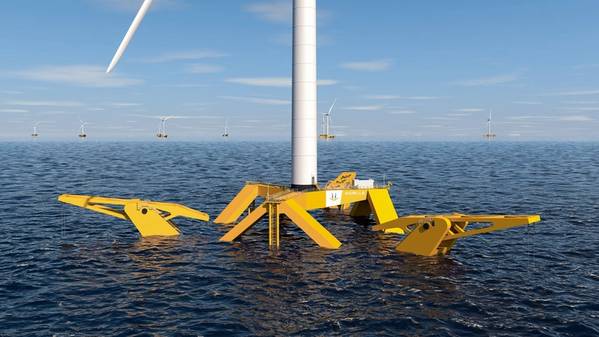
Sept. 21 (offshoreWIND.biz) Gazelle Wind Power has developed and tested a new floating offshore wind platform designed to support 18 MW turbines and beyond in extreme offshore conditions, with the company’s preliminary cost assessment indicating 44 per cent lower CAPEX and 52 per cent lower LCOE than the benchmark semi-submersible designs used in the study.
The Ireland-based company said on 21 September that the design is being developed as part of its work with a major Asian utility on a floating offshore wind project at a typhoon-prone site.
The new platform was assessed under normal and extreme conditions, including a 50-year extreme wind speed of 59.8 m/s at a hub height of 155 metres and a 50-year significant wave height of 14.2 metres.
According to the Gazelle, simulations showed roll and pitch angles below 5 degrees, while tower-top accelerations and tower-base loads remained within the project’s design criteria.
The platform retains the core principles of Gazelle’s technology, the company said, and uses a central counterweight and three Articulated Mooring Frames (AMFs) with near-vertical mooring lines to provide passive restoring force without an active ballast system.
The latest configuration features a tripod support structure, upgraded AMFs and revised hull geometry. Gazelle said these changes improve hydrodynamic performance, mooring flexibility and load distribution while reducing structural weight and increasing damage tolerance.
The preliminary costing exercise compared the design with standard semi-submersible benchmarks. Gazelle attributed the potential cost reductions to lower structural and mooring requirements, a compact footprint, modular steel construction and the use of existing port infrastructure.
The company also said the platform can be installed and maintained using tow-to-port operations, reducing reliance on specialist offshore vessels.
Gazelle has been developing its hybrid floating platform for several years. In 2021, the technology received a statement of feasibility from DNV, while basin tests of a 10 MW version carried out in Spain in 2022 confirmed the main principles of the platform concept and showed reduced pitch motions under extreme conditions.
The company unveiled a third-generation version of the platform in 2023, with a design focused on reducing steel use, simplifying assembly and making use of existing port infrastructure. Gazelle said at the time that the platform could be scaled to turbines of 15 MW and above.
Gazelle is also developing the 2 MW Nau Azul floating wind demonstrator off Aguçadoura, Portugal. The project received a 10-year maritime-space permit in April 2025, following a EUR 11.4 million funding round for the demonstrator in November 2024.
In October last year, Gazelle Wind Power signed a memorandum of understanding (MoU) with Titan Wind Energy, a Chinese manufacturer of onshore and offshore wind turbine components, which also has offices in Denmark and Germany.
Under the MoU, the companies agreed to broaden and deepen cooperation, and to work jointly to advance the industrialisation and global deployment of floating wind technology. The agreement also involves Gazelle’s floating offshore wind platform technology being optimised to suit Titan Wind’s offshore equipment and manufacturing standards.


Leave a comment