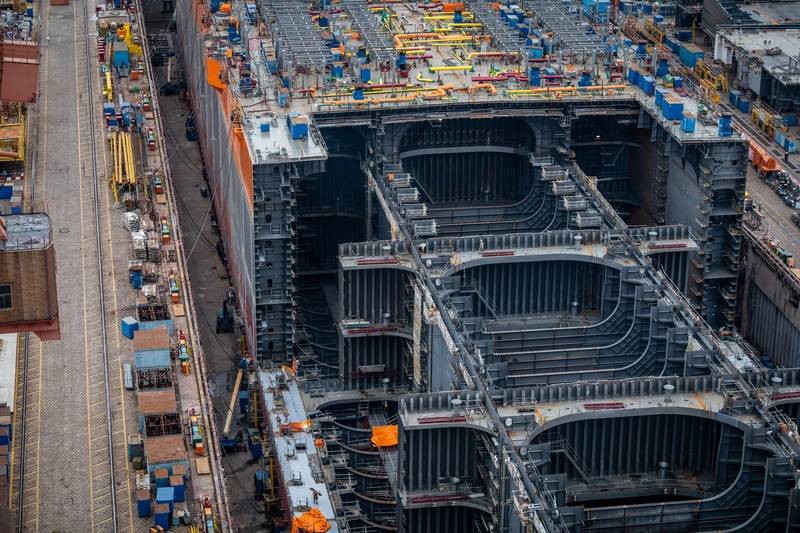
Sept. 13 (agenciainfra.com) Lourenço Fróes, coordinator of Petrobras’ New FPSO Program (Profort), indicated on Friday (11) that the state-owned company is considering renewing the operating contracts for the FPSOs (Floating Production, Storage, and Offloading units) in the Seap (Sergipe Deepwater) project with the builder and operator SBM Offshore. Currently, the contracts run for six and a half years.
The contracts for the project’s two FPSOs represent Petrobras’ first use of the BOT (Build, Operate, and Transfer) model, in which the contractor is responsible for the design, construction, assembly, and operation of the asset for an initial period defined in the contract. Afterward, operations are transferred to Petrobras. In the case of Seap, the contracts between the parties were signed in May 2026, with a total value exceeding US$ 7.8 billion.
According to Lourenço, it is precisely this initial operating period that could be extended. The contract includes a provision for a seven-year renewal which, if exercised, could bring SBM’s operational tenure to 13.5 years.
“It is a renewable contract, and it is possible that this renewal will take place—extending the window during which Petrobras is not the operator,” Lourenço said at an event organized at the headquarters of Firjan (Federation of Industries of the State of Rio de Janeiro).
Subsequently, SBM’s commercial and business development manager, Kássia Paste, expressed interest in the contract renewal, noting that the company generally operates vessels for 20 to 22 years—a timeframe well beyond the maximum potential duration of the Seap contracts.
“Even with an extension [of operations], the timeframe would still be shorter than that of chartered FPSOs. The potential of the Sergipe region is immense. We don’t want to go there, experience this, and simply leave. What we have done in other countries demonstrates our desire to leave a lasting legacy,” Kássia said. In a presentation, the executive revealed plans to launch local engagement initiatives, including the opening of an office in Sergipe as early as 2027. The first production vessel, Seap II, is projected to achieve first oil in 2030, while the second, Seap I, is expected to do so in 2031. These are considered “twin” FPSOs—virtually identical units—each with the capacity to produce 120,000 barrels of oil per day and process 12 million cubic meters of natural gas daily.
BOT Model
Lourenço, from Petrobras, reiterated that the Seap project and its tender process demonstrated the viability of the BOT (Build-Operate-Transfer) model, which is expected to be adopted for other Petrobras projects. According to him, the unified contracting of two FPSOs was a key differentiator in the process, making it more attractive to suppliers.
The BOT model will also be adopted for the Albacora revitalization project in the Campos Basin; the tender for a new platform (P-88) is currently underway, with five bids already submitted. In this instance, the new business model was crucial to unlocking a project that had previously been slated for operation in 2027 but is now expected to come online after 2031.
In this case, Malaysia’s Yinson took the lead with the lowest bid—US$ 2.29 billion—coming in below the proposals from China’s COOEC (US$ 2.84 billion), India’s Shapoorji Pallonji (US$ 2.9 billion), Malaysia’s MISC (US$ 3.05 billion), and Norway’s BW Offshore (US$ 3.19 billion). Petrobras will now analyze the submitted documents to confirm the winning company.


Leave a Reply