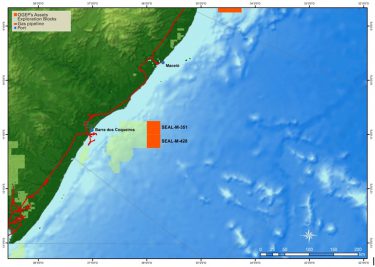
Aug. 24 (PN) Petrobras’s board met last week and reached a decision that could alter the course of one of the sector’s most anticipated projects. Due to discussions surrounding the “gas release” program, the company deemed it prudent to hit the brakes and reevaluate the export pipeline project for the Sergipe Deepwater (SEAP) development, anccording to an industry source. However, the intention is not to abandon the SEAP project, but rather to rethink how the gas produced at the field would be exported.
One option under consideration is installing a liquefaction barge near the platform, allowing the produced gas to be converted into LNG offshore and exported without being subject to gas release regulations. The export pipeline originally envisioned for SEAP was planned to span approximately 134 km—comprising 111 km offshore and 23 km onshore.
As a reminder, “gas release” is a mechanism involving the offering of gas volumes to the market, a topic currently being debated by the National Agency of Petroleum, Natural Gas and Biofuels (ANP). According to the source who spoke to Petronotícias, Petrobras’s internal assessment suggests that potential rule changes could impact the economic viability of the pipeline project designed for SEAP.
Earlier this month, the ANP approved a draft of the program for public consultation. Under the proposed rules, 100% of the state-owned company’s own production would be exempt. The program would only apply to natural gas acquired by the state-owned company from other oil firms at the wellhead, gas belonging to the Federal Government, and gas imported from Bolivia via the Gasbol pipeline. However, the plan may still undergo changes and refinements during the public consultation process. The program will focus on introducing the gas into the wholesale market to supply non-thermoelectric consumers.
Petrobras’s management is concerned that the obligation to make a portion of gas production available to the market could reduce the volume allocated for export and, consequently, compromise the profitability of the originally planned gas offloading project.
SEAP FPSO MAY BE RELOCATED TO THE EQUATORIAL MARGIN
According to a source, another possibility being discussed by the company’s management involves transferring one of the platforms initially intended for the SEAP project to the Equatorial Margin. This would still depend on the final results of the drilling operations Petrobras plans to conduct in block FZA-M-059, off the coast of Amapá in the Foz do Amazonas Basin.
Petrobras has already ordered two platforms from SBM Offshore for the SEAP project: the P-81 (SEAP I) and the P-87 (SEAP II), each with a production capacity of 120,000 barrels of oil per day (bpd) and 10 million cubic meters of gas per day.
The SEAP I project covers light oil reservoirs—considered to be of high quality—within the Agulhinha, Agulhinha Oeste, and Palombeta fields, located in the BM-SEAL-10 and BM-SEAL-11 concession areas. Petrobras operates the BM-SEAL-11 concession—holding a 60% stake in partnership with IBV Brasil Petróleo LTDA (40%)—and the BM-SEAL-10 concession, where it holds a 100% stake.
The SEAP II project covers light oil reservoirs—considered to be of high quality—within the Budião, Budião Noroeste, and Palombeta fields, located approximately 80 km offshore in the BM-SEAL-4, BM-SEAL-4A, and BM-SEAL-10 concession areas, respectively. Petrobras is the operator of the BM-SEAL-4 concession—holding a 75% stake in partnership with ONGC Campos Limitada (25%)—as well as the BM-SEAL-4A and BM-SEAL-10 concessions, where it holds a 100% stake.


Leave a Reply