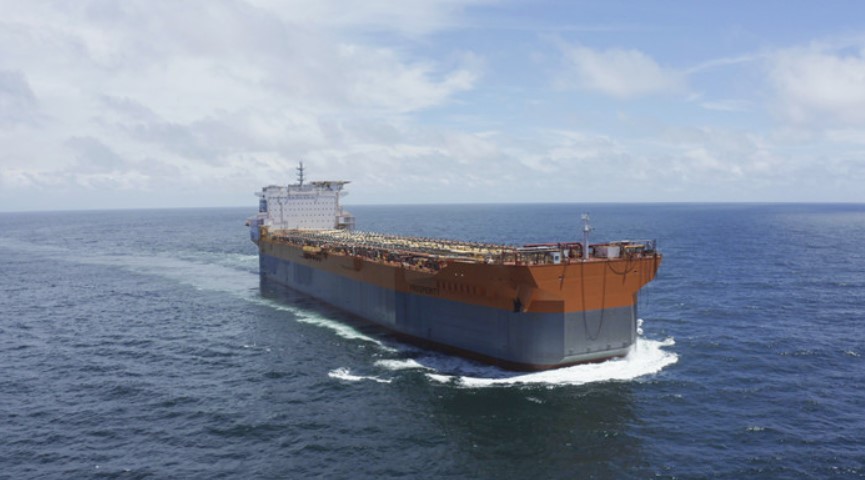
Aug.10 (cnnbrasil) German equipment manufacturer Siemens Energy has signed a contract with the Dutch company SBM Offshore to supply power generation and gas compression systems. These systems will be installed on the P-81 and P-87 platforms, which are destined for Petrobras projects in the Sergipe-Alagoas Basin. The value of the contract was not disclosed.
In total, the manufacturer will supply 16 main modular systems—known as skids—with eight going to each floating production unit. The equipment will integrate the systems responsible for both supplying electricity to the units and compressing the gas produced offshore.
For each FPSO, the Siemens Energy package will include four gas turbine-driven generators for electricity supply, three gas turbine-driven compressor trains for processing and exporting production, and one electric compressor for gas injection into the reservoir.
Marcela Souza, Senior Vice President for Latin America at Siemens Energy, told CNN that the project reinforces the company’s partnership with Petrobras and involves manufacturing a significant portion of the equipment in Brazil.
The skids will be produced primarily at Siemens Energy’s industrial complex in Santa Bárbara d’Oeste, in the interior of São Paulo state, meeting the project’s local content requirements. However, some key components will be imported; the turbines will be manufactured in Montreal, Canada, while the compressors will be produced in Germany.
“It is a significant project for the country because, beyond gas exploration and the situation in the Northeast region, we have the opportunity to utilize this gas; it will be piped to shore and can be commercialized,” says Marcela.
Siemens Energy expects the contract to generate approximately 400 direct jobs and another 500 indirect jobs in the country. For the executive, the project also highlights the importance of maintaining an industrial base within Brazil, amidst the growing presence of Asian suppliers—particularly Chinese ones—in market segments where manufacturers with local production previously held a larger share.
Marcela advocates for the government to adopt trade defense measures capable of preserving the competitiveness of the industry established in the country. “Once we lack this protection for the local manufacturing market, we lose competitiveness and will have to look at projects outside Brazil,” she says.
Each of the two platforms will have the capacity to generate approximately 100 megawatts (MW) of offshore electric power. In terms of consumption equivalence, this output would be sufficient to supply a city of around 500,000 inhabitants.
Initial equipment deliveries are scheduled for late 2027. The supply schedule will continue throughout 2028, when the final deliveries are expected to take place.
The P-81 and P-87 platforms are part of the Sergipe Deepwater I and II projects, known as SEAP I and SEAP II.
In April, Petrobras announced investments exceeding R$ 60 billion in the two projects. Together, the platforms will have the capacity to produce up to 240,000 barrels of oil per day and process 22 million cubic meters of natural gas daily.
 Brazil Energy Insight
Leave a comment