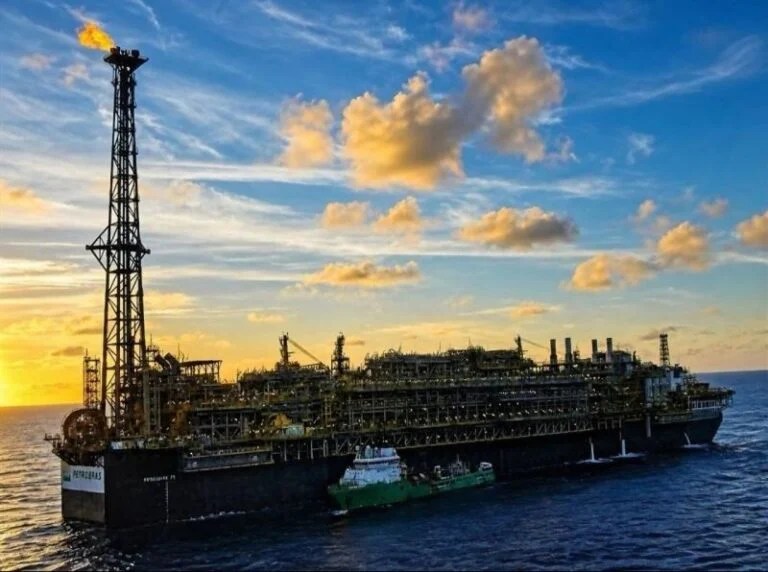
July 29 – Petrobras second quarter of 2026 production of oil and natural gas reached a record 3.34 million barrels of oil equivalent per day (boed)—up 14.1% from the same quarter last year and 3.4% from the first quarter of 2026. This growth was driven primarily by increased operational efficiency and the production ramp-up of the Maria Quitéria FPSO (Jubarte field), Alexandre de Gusmão FPSO (Mero field), and P-78 FPSO (Búzios field), as well as the start of production from the P-79 FPSO (Búzios field). These factors were partially offset by the natural decline of mature fields.
During the quarter, 10 new production wells came online: four in the Campos Basin and six in the Santos Basin.
Key Events
Increased operational efficiency across assets resulted in an additional 70,000 barrels per day (mbpd) of production compared to the same quarter of the previous year (2Q25). This gain stems from operational efforts and spending on maintenance and integrity, which enhance the reliability of production systems. This performance is equivalent to the production capacity of the Anna Nery FPSO at the Marlim field.
On June 23, platforms in the Búzios field achieved a record average production of 1.1 million bpd, surpassing the 1-million-bpd mark reached in October 2025. Just three days later, on June 26, the Búzios platforms exceeded that figure, reaching an average production of 1.2 million bpd. These records were achieved through the expanded activity of the P-78 and P-79 platforms, which are currently ramping up production.
Additionally, in June, the Búzios field platforms achieved an average monthly production exceeding 1 million bpd for the first time. This milestone was reached 8.2 years after the start of commercial production from the field’s definitive production systems, outperforming the platforms producing in the Tupi field, which reached the same level in 8.8 years.
The P-79 platform began production on May 1st in the Santos Basin pre-salt area—three months ahead of the date projected in the 2026–2030 Business Plan (PN 26–30) and a total of five months ahead of the previous year’s plan (PN 25–29). As the eighth platform in the Búzios field—with a production capacity of 180,000 barrels per day (bpd) and gas compression capacity of 7.2 million cubic meters per day—the unit will increase the field’s installed production capacity to approximately 1.33 million bpd. The unit injected its first gas on June 26, setting another record for Petrobras-owned platforms: achieving this just 56 days after the start of production.
The FPSO Almirante Tamandaré, which also produces in the Búzios field, set a record for average monthly oil production of 253,000 bpd in June 2026, maintaining its position as the highest-producing platform in Brazil.
The Mero asset recorded an average production of approximately 740,000 bpd in the second quarter of 2026, with a high level of operational efficiency.
In addition to Búzios and Mero, other Santos Basin assets have maintained high production levels—stable since 2022—even without the introduction of new systems. These assets—such as Tupi, Sépia, Atapu, Itapu, Sapinhoá, and Berbigão—demonstrate consistent operational performance, which, alongside major portfolio developments, sustains production above 1.5 million bpd. In the Campos Basin, oil production was 559,000 bpd in 2Q26—the second-highest output since 4Q23—driven by gains from investments and asset management and optimization measures in the basin, thereby reversing the downward trend.
Several production records were set this quarter, most notably:
Total operated production in 2Q26: 4.87 MM boed (previous record of 4.65 MM boed in 1Q26).
Total own production in 2Q26: 3.34 MM boed (previous record of 3.23 MM boed in 1Q26).
Total operated pre-salt production in 2Q26: 4.24 MM boed (previous record of 4.01 MM boed in 1Q26).
Total own pre-salt production in 2Q26: 2.78 MM boed (previous record of 2.66 MM boed in 1Q26).
Click here for the full 2Q26 Production & Sales Report .


Leave a comment