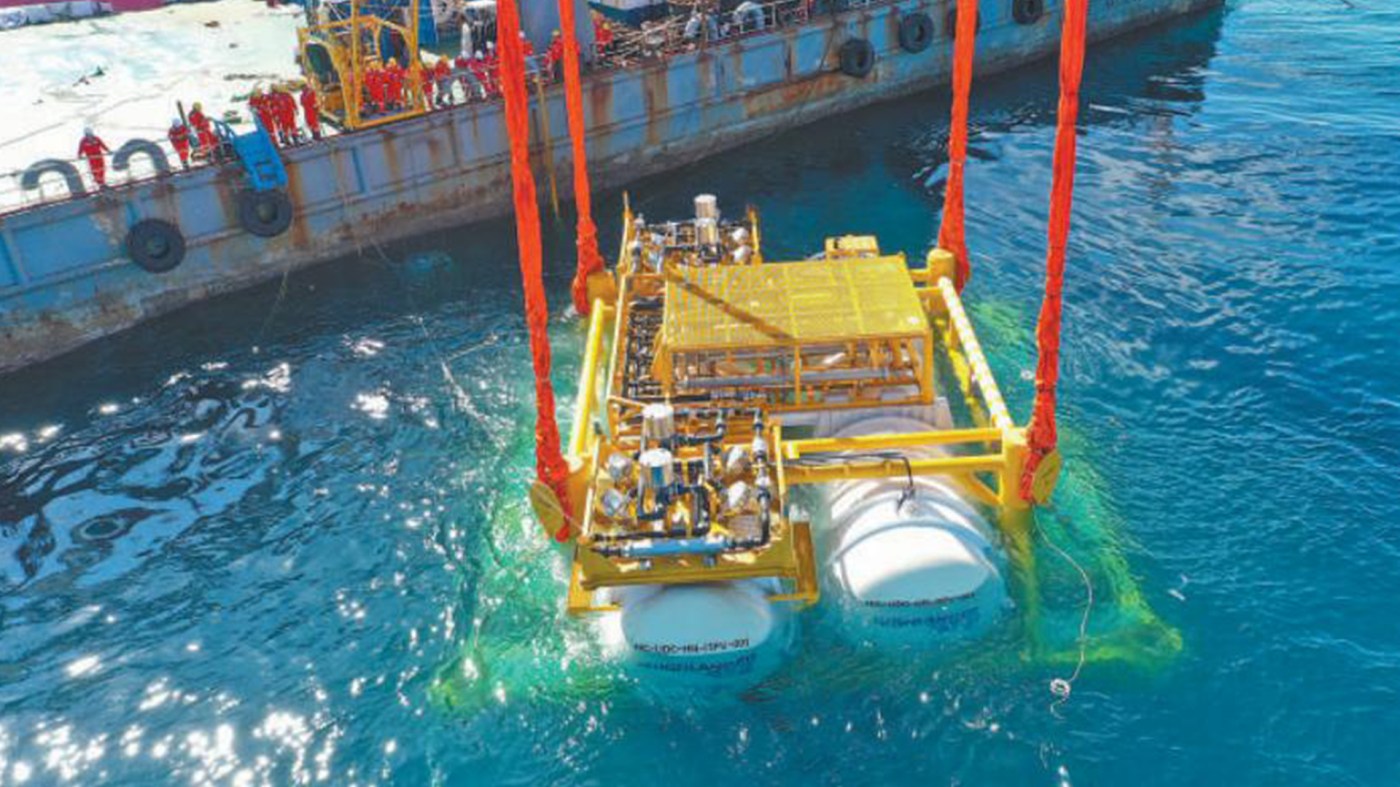
May 20 (interestingengineering) China’s offshore wind-powered underwater data center, said to be the world’s first of its kind, has entered full commercial operation off the coast of Shanghai’s Lingang Special Area.
The $226M project was officially launched in June 2025 through a cooperation agreement signed between the Lingang Special Area administrative committee, Shanghai Lingang Special Area Investment Holding Group, and HiCloud Technology.
Separately, HiCloud also signed operational agreements with partners, including Shenergy Group, Shanghai Telecom, CCCC Third Harbor Engineering, and others. China Telecom has deployed GPU clusters within the facility as a computing client.
Having completed the construction in October 2025, the full-scale operations began last week following initial trials earlier this year.
Offshore wind powers underwater computing
The underwater data center (UDC) is positioned between the first and second phases of Lingang’s offshore wind farm.
Pressure-resistant subsea modules housing nearly 2,000 servers are deployed underwater adjacent to offshore wind turbines, allowing the facility to draw electricity directly from renewable energy sources.
The project was developed in two phases, beginning with a 2.3 MW demonstration facility before scaling to a total capacity of 24 MW.
GPU clusters from China Telecom and local provider LinkWise have been deployed inside the underwater modules to support AI workloads, big data annotation, and domestic large language model (LLM) development.
According to project developers, the system supports workloads ranging from artificial intelligence and big data annotation to 5G infrastructure and domestic large language model development.
Seawater cooling reduces energy demands
Unlike conventional land-based facilities that rely heavily on industrial chillers and HVAC systems, the Shanghai UDC uses seawater from the surrounding area as a passive cooling mechanism.
A representative from HiCloud Technology explained the process:
“Our backplane air conditioners draw in hot air generated from the servers and change the refrigerant in the copper pipes from liquid to gas. The gas rises to the cooling layer of the upper module by its own buoyancy, where it exchanges heat with a heat exchanger through seawater and changes back from gas to liquid.”
“Finally, gravity returns it to the server room of the data warehouse, forming a heat exchange system that does not require power,” he continued.
Chinese media reports state the facility maintains a Power Usage Effectiveness (PUE) of around 1.15, placing it among the most energy-efficient large-scale data centers currently in operation. Traditional enterprise data centers often operate closer to 1.5 or higher due to cooling and infrastructure overhead.
Developers claim the underwater design reduces electricity consumption by 22.8%, eliminates freshwater use, and cuts land use requirements by more than 90%.
Underwater infrastructure challenges
Underwater computing infrastructure introduces several operational challenges despite its efficiency benefits. Saltwater corrosion, long-term pressure sealing, subsea cable reliability, and hardware accessibility remain major engineering concerns for operators.
Replacing failed components underwater is significantly more difficult than servicing conventional server racks, forcing operators to depend on sealed modular systems, remote monitoring, and highly redundant infrastructure designed to minimize physical intervention.
The Shanghai project follows earlier experimental underwater deployments such as Microsoft’s Project Natick, which tested submerged data center capsules off the coast of California in 2015, followed by a larger deployment off Scotland’s Orkney Islands in 2018
Although Microsoft discontinued the project by 2024 without proceeding to commercial deployment, the trials demonstrated lower hardware failure rates in underwater environments.
As AI infrastructure power and cooling demands continue to rise globally, offshore-powered and ocean-cooled data centers are increasingly being explored as alternative approaches for future computing infrastructure.
 Brazil Energy Insight
Leave a comment