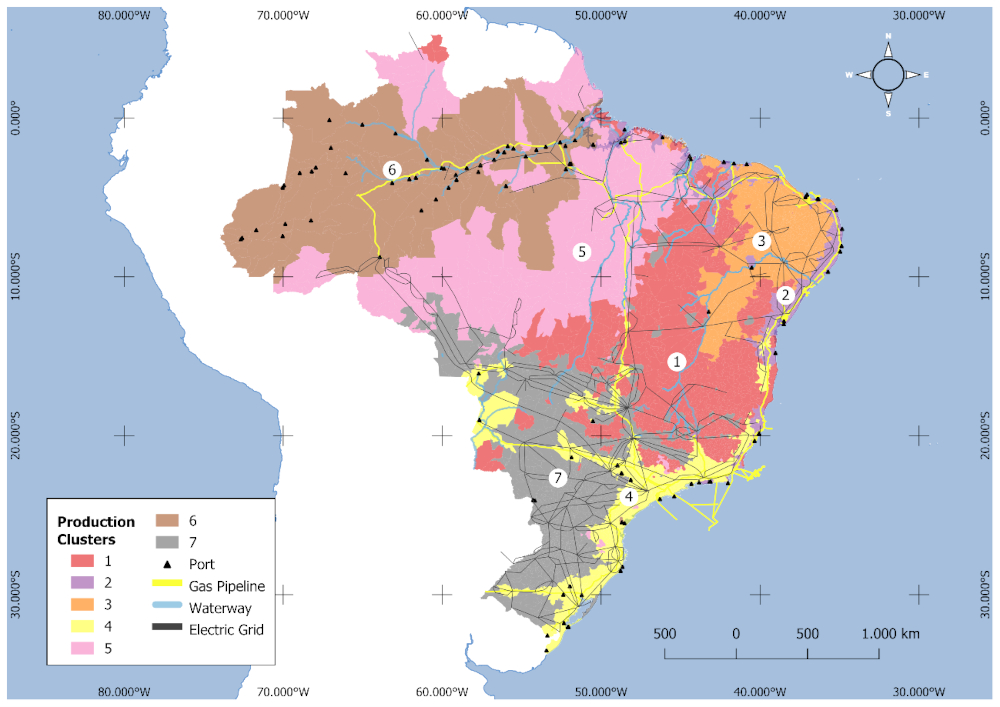
April 6 (TN) A study analyzing data from thousands of Brazilian municipalities identified regions with the greatest potential for the production and use of green hydrogen – a fuel considered strategic for the decarbonization of emission-intensive industrial sectors. The research shows that the country has favorable conditions for developing this new energy chain, but also reveals a significant challenge: the main production and consumption locations do not geographically coincide, which will require significant investments in transportation and distribution infrastructure.
The results were published in the International Journal of Hydrogen Energy by Celso da Silveira Cachola and Drielli Peyerl. The work was developed at the Research Center for Innovation in Greenhouse Gases (RCGI), one of the Applied Research Centers (CPAs) of FAPESP, based at the University of São Paulo (USP), in partnership with Shell Brazil and with support from the National Agency of Petroleum, Natural Gas and Biofuels (ANP).
According to Peyerl, from the Institute of Energy and Environment (IEE) at USP and the project “Energy transition through the lens of Sustainable Development Goals” (ENLENS) at the University of Amsterdam (Netherlands), the objective was to answer a central question for planning the energy transition in the country: “We wanted to identify which regions of Brazil have the greatest potential to produce and consume green hydrogen in the context of industrial decarbonization.”
Hydrogen has been identified as one of the most promising alternatives for reducing emissions in industrial sectors known as “hard-to-abate” – those in which decarbonization still faces major obstacles, whether due to technological, energy, or economic limitations. These sectors include steelmaking, oil refining, and part of the chemical industry. In these activities, hydrogen can replace fossil fuels in high-temperature processes or act as a raw material in chemical reactions.
When produced by water electrolysis using electricity from renewable sources such as hydroelectric, solar, or wind power, it is called “green hydrogen” because it generates virtually no greenhouse gas emissions during the production process.
According to Peyerl, the choice of electrolysis as a reference in the study is due to the technological consolidation of this method: “Electrolysis is a relatively mature technology. When we analyze technological development, we use the so-called Technology Readiness Level. And electrolysis is already at a high level of maturity, while other routes are still in experimental stages.”
Despite this, the researcher emphasizes that hydrogen should not be seen as a universal solution to all energy challenges. “Energy transition is diversification. In some sectors, hydrogen fits like a glove, especially in industrial processes that are difficult to decarbonize. In other cases, direct electrification may be more efficient and cheaper,” she says.
To map the development potential of this technology in Brazil, researchers gathered data from 5,569 municipalities to assess production potential and from 2,569 municipalities to estimate industrial consumption potential. The analysis considered six main variables: geographic location of the municipalities, proximity to energy infrastructure (electricity grid, gas pipelines, and ports), industrial CO₂ emissions, water security index, solar incidence, and average wind speed.
This information was analyzed using geographic information systems (GIS) and unsupervised machine learning techniques, including k-means, hierarchical clustering, and DBSCAN algorithms. The methodology combined statistical and spatial analysis to identify patterns across Brazilian territory.
According to Peyerl, the method used is based on the overlaying of different layers of geographic information: “The idea is to work with what we call a layered methodology. You create separate maps – for example, of solar potential, wind potential, energy infrastructure, or industrial emissions – and then overlay these maps to identify regions where several favorable factors are concentrated.” This procedure allows visualizing areas where, for example, a large availability of renewable energy and high industrial demand for decarbonization coexist.
The results showed the existence of seven clusters with high potential for green hydrogen production and ten with greater potential for industrial consumption. The Northeast appears as the region with the greatest potential production capacity, thanks to the combination of high solar and wind energy resources. Consumption clusters, however, are concentrated mainly in the South and Southeast regions, which house a large part of Brazil’s industrial park and register high levels of industrial emissions. This spatial difference creates a structural challenge for the development of the hydrogen economy in the country. “Today we are very focused on production, but we need to look at the entire value chain. The great challenge is to ensure that the hydrogen produced actually reaches the sectors that will use it,” emphasizes Peyerl.
Potential green hydrogen consumption clusters for industrial decarbonization in Brazil (image: Celso da Silveira Cachola and Drielli Peyerl)
One of the strategies discussed by the researchers to overcome this spatial gap is the creation of hydrogen hubs – industrial centers where production and consumption are close together. “When you create a hub, you produce hydrogen close to the industries that will use it. This reduces energy losses and lowers transportation costs,” comments Peyerl. According to the researcher, this model has been discussed in several countries as a way to accelerate the adoption of hydrogen in industry. Furthermore, the formation of these hubs can facilitate the planning of energy and logistics infrastructure, allowing investments to be concentrated in strategic regions.
The study also highlights the need to develop new transportation and storage systems to make the hydrogen chain viable in Brazil. Among the alternatives are: hydrogen-adapted gas pipelines, maritime transport, and conversion into derivatives, such as green ammonia. “For long distances, it is often preferable to convert hydrogen into green ammonia, because there is already know-how to transport ammonia by ship and adapted port infrastructure,” Peyerl points out.
Another relevant issue is the energy cost of production. Hydrogen generation through electrolysis requires a large amount of renewable electricity, which reinforces the importance of locating production plants in regions with abundant solar or wind energy (read more at: agencia.fapesp.br/55548).
The study reinforces Brazil’s strategic position in the energy transition. The country has one of the most diversified and renewable energy matrices in the world. According to the National Energy Balance (BEN), prepared by the Energy Research Company and the Ministry of Mines and Energy, the participation of the main sources in the Brazilian energy matrix is as follows: oil and derivatives, 34.3%; sugarcane biomass (ethanol and bagasse), 18.0%; hydroelectric, 12.4%; natural gas, 12.2%; charcoal, 8%-9%; coal, 5.3%; nuclear, 1.4%; wind, 1-2%; solar, 1%; other renewables, 7% (base year 2023). It should be noted that approximately 45% to 50% of Brazil’s energy matrix is renewable, while the world average is around 15%. Furthermore, more than 80% of Brazilian electricity comes from renewable sources, a value far superior to that of most industrialized countries. According to the National Energy Plan 2050, the incorporation of hydrogen could play an important role in further decarbonizing Brazil’s energy matrix, especially in the industrial sector.
However, as Peyerl emphasizes, the country’s energy strategy must explore its diverse resources: “Brazil has enormous potential for hydrogen, but also for electrification, biomethane, biomass, and other energy routes. The challenge is to identify which solution makes the most sense in each region.”
This study was also supported by FAPESP through a Research Grant – Young Researchers, awarded to Peyerl.
The article “Mapping green hydrogen clusters in Brazil: A data-driven approach for industrial decarbonization” can be accessed at sciencedirect.com/science/article/abs/pii/S0360319925062056.
 Brazil Energy Insight
Leave a comment