March 16, (oilnow.gy) Automation, digital technologies, and emissions reduction are expected to shape the next generation of floating production, storage and offloading (FPSO) vessels, according to discussions at the Deepwater Development Conference in Lisbon, Portugal.
The conference, hosted by World Oil and Gulf Energy Information, continued on March 11 with contractor panels, technical sessions, and keynote presentations focused on offshore development.
During a keynote address, Boyd Howell, Director of Sales and Marketing at MODEC, reflected on the evolution of FPSOs.
“We think in decades, not projects,” Howell said. “This has guided our work in Brazil and is guiding our work in Guyana.”
He noted that Brazil has played a major role in advancing deepwater development.
“Brazil is one of the best examples of deepwater offshore evolution, and we operate 13 vessels there.”
Howell explained that FPSO digitalization has progressed through three phases. In the first phase, before 2000, automation was the primary focus. Between 2000 and 2015, the industry concentrated on connectivity and data accumulation. Since 2015, intelligence and advanced data use have taken priority.
“The industry can expect that offshore facilities, including FPSOs, will be increasingly automated,” Howell said.
He also highlighted new technologies aimed at lowering emissions from offshore production systems.
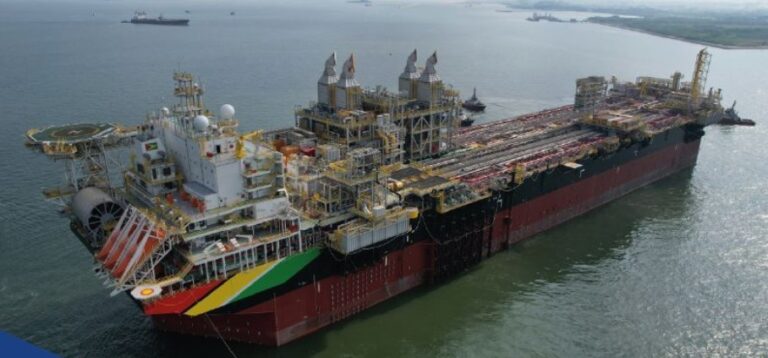
Howell noted that the Bacalhau FPSO offshore Brazil is the first vessel of its kind to feature a combined cycle gas turbine system, which helps achieve significantly lower carbon dioxide emissions intensity.
He said future production vessels will incorporate efficiency and emissions performance from the initial stage. “Performance, emissions reduction, and efficiencies will be designed into every production vessel from the start of its construction.”
MODEC currently holds FPSO engineering, procurement, construction, and installation (EPCI) contracts for ExxonMobil Guyana’s Uaru and Hammerhead projects in the Stabroek Block. The company will also provide operations and maintenance services for the vessels once they are operational.
Uaru targets more than 800 million barrels of recoverable oil, with initial production expected at about 250,000 barrels per day. Hammerhead is being engineered to produce around 150,000 barrels of oil per day and about 95 million cubic feet per day of gas.
 Brazil Energy Insight
Leave a comment