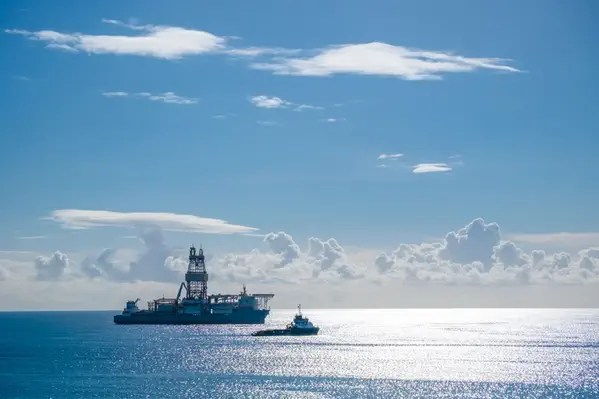
Feb. 23 – Africa and South America are expected to lead high-impact exploratory drilling in 2026, with a forecast of 19 and 15 wells, respectively, according to the consulting firm Westwood Global Energy Group. In Brazil, the highlights are the Tupinambá well, from BP, and the Morpho well, from Petrobras. In total, the company estimates the completion of approximately 65 high-impact wells worldwide throughout the year, a volume similar to that recorded in 2025. In South America, the Suriname-Guyana and Santos and Campos basins in Brazil are expected to concentrate the majority of the activity.
“In the Santos Basin, BP’s Tupinambá well is highlighted as one of the main targets for the year, focusing on a large pre-salt structure near the Bumerangue discovery, scheduled for 2025. Meanwhile, in the Brazilian Equatorial Margin, in deep waters, Petrobras continues drilling the Morpho well in the Amazon River mouth. Further southeast, in the Potiguar Basin, the state-owned company intends to drill the Mãe de Ouro well, following up on the Anhangá discovery, announced in 2024,” stated Jamie Collard, Westwood’s exploration research manager.
In Suriname, a higher volume of exploratory wells is expected compared to Guyana, where the recent focus has been on evaluating and developing projects in the Stabroek license. Petronas is expected to lead high-impact drilling in Suriname, with at least two wells planned. Shell recently completed the Araku Deep well in the Demerara Plain, without commercial success. Other significant wells may be drilled in deep waters off Uruguay and the coast of Peru.
On the African continent, four wells are planned in the Orange Basin, Namibia. Chevron plans to drill the Gemsbock prospect, marking the first well in the Walvis frontier basin since 2018. In the Tano-Ivory Basin, four wells are expected to be completed, three of which are operated by Murphy Oil. The Civette well was completed unsuccessfully in January 2026; Caracal is currently being drilled; and Bubale is expected to begin operations in the first quarter.
Significant tests are also expected in frontier basins, including Eni’s Matsola well in the offshore portion of the Sirte Basin; TPAO’s Curad-1 in Somalia; Shell’s Velox in the Herodotus Basin; and Azule Energy’s Piambo in the Namib Sea.
According to Westwood, although drilling programs are still being consolidated throughout the first quarter, the current scenario indicates a continuation of the slowdown recently observed in high-impact exploration. This is because companies have adopted greater discipline in capital allocation in the face of the price environment, while expanding their exploration portfolios to preserve future opportunities.
NORTH AMERICA AND ASIA PACIFIC
In North America, activity is expected to remain moderate, with approximately five high-impact wells planned. The highlight is BP’s Conifer-1 in the Gulf of Mexico, marking the company’s return to the Paleogene in 2026. The company is also evaluating a low-permeability prospect near the Kaskida discovery. Shell, Chevron, and TotalEnergies are also expected to drill significant wells in the region. There are no plans to complete high-impact wells on the northern slopes of Alaska or in eastern Canada.
In the Asia-Pacific region, the estimate is for 10 to 12 wells in 2026. Tests are planned for deepwater carbonates off the coast of Papua New Guinea, in Mailu, and in Malaysia, in the Jampuk and Langka prospects. Petronas may start drilling at the Akbar-1 well in the Bobara PSC, in eastern Indonesia, ending a 12-year hiatus in deepwater drilling in the area.
Eni continues its campaign in the Kutei Basin, Indonesia. In India, ONGC and Oil India are expected to complete exploratory campaigns in Andaman and Kerala-Konkan early in the year, while Vedanta (Cairn India) may proceed with deepwater drilling in block KG-DWHP-2017/1, in the Krishna-Godavari Basin. In Australia, Santos plans to resume exploration in the Roebuck Basin from the end of 2026, focusing on the Curie and Ara prospects.
 Brazil Energy Insight
Leave a comment