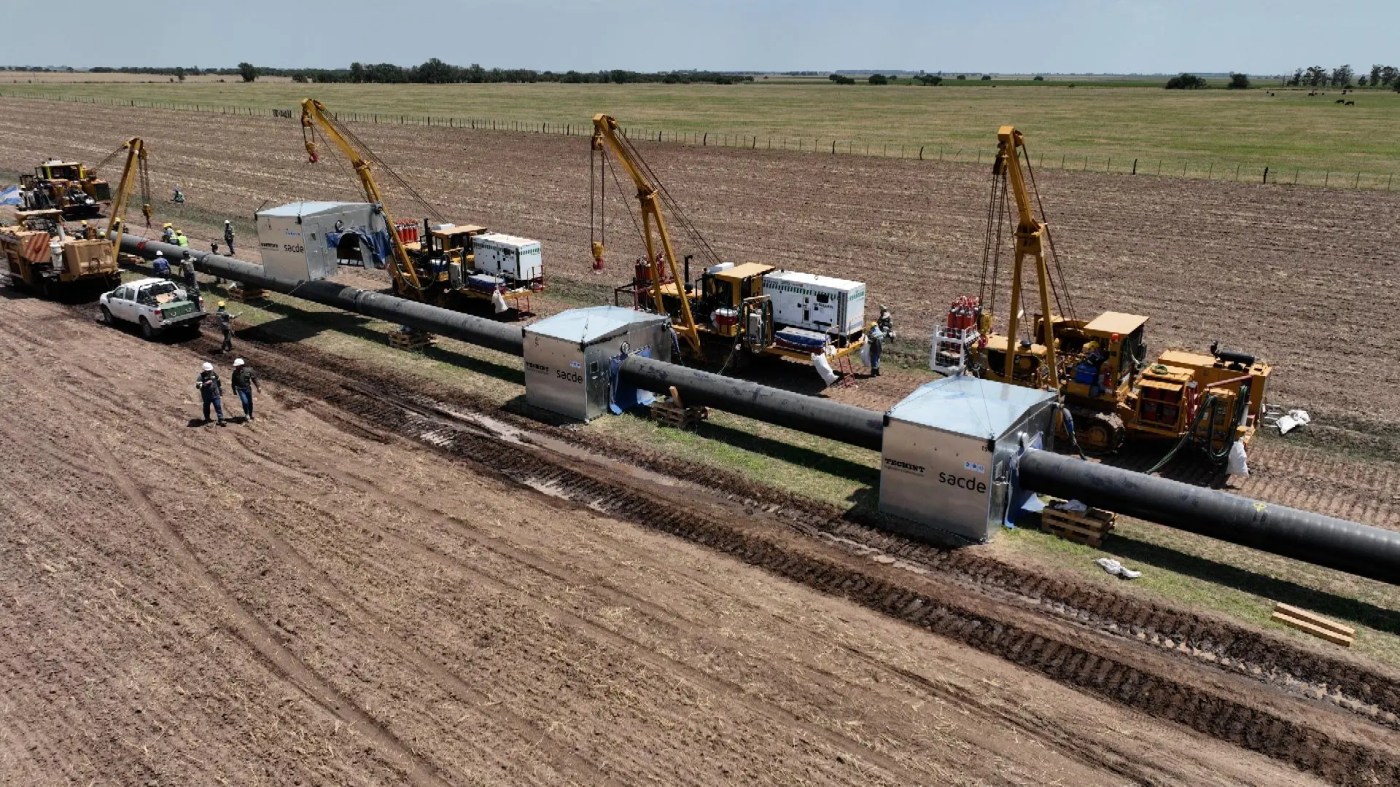
Feb 5 (Reuters) – Argentina could surpass last year’s record energy trade surplus in 2026, supported by infrastructure that has improved the country’s capacity to ship oil and gas from the Vaca Muerta shale formation, analysts said.
The 2026 energy trade surplus could range from $8.5 billion to $10 billion, and would depend mainly on oil production, three analysts told Reuters.
Boosting energy exports and reducing dependence on imported gas are central goals for Argentina’s government, which seeks to increase foreign-currency inflows, strengthen central bank reserves and bolster investor confidence.
Argentina posted a record energy surplus of $7.8 billion last year, with exports of $11.1 billion, up nearly 13% from 2024, while imports fell 18% to $3.3 billion.
Development of Vaca Muerta – part of Argentina’s Neuquen basin – has helped reverse a deficit that peaked at nearly $7 billion in 2013. Vaca Muerta production reached about 600,000 barrels of oil per day in 2025.
“The engine of growth is Vaca Muerta, since the rest of the basins (of conventional hydrocarbons) are in decline, with a drop of 4.9% [of production] in 2025,” said Fernando Bazan of consulting firm Abeceb.
He said oil exports, which accounted for 86% of the 2025 energy surplus, will be the key driver this year too.
Argentina’s total trade surplus in 2025 stood at $11.3 billion.
Senator Agustin Monteverde, a trained economist, also expects a strong contribution from energy, projecting a surplus due to exports enabled by easier offloading from Vaca Muerta.
“The greater transport capacity, for both oil and gas, will strengthen exports but will also reduce our dependence on (imported) gas, and we are seeing growth in exports not only regionally but also to the United States, which is becoming consolidated as the main buyer,” he said.
COMPANIES INVEST IN VACA MUERTA
Companies are betting on continued growth in oil output. State-controlled energy firm YPF, together with Pan American Energy, Pluspetrol, Vista and Pampa Energia, is developing the Vaca Muerta Oil Sur project, which includes a 550,000 barrel-per-day oil pipeline and a plant and storage tanks at the Punta Colorada terminal in Rio Negro. The project has secured $2 billion in financing.
YPF chief executive Horacio Marin said in January the project would generate more than $15 billion a year in exports.
In gas, capacity has been added to a trunk pipeline from Vaca Muerta, and work is underway to reverse the Northern Gas Pipeline to supply northern Argentina, replacing gas previously imported from Bolivia and allowing for more exports to Brazil.
Argentina also aims to become a global liquefied natural gas exporter, which would require major infrastructure to move gas to an Atlantic port for liquefaction and export.
However, analysts expect Argentina will still need gas imports to cover peak winter demand.
“The major promises of a jump in gas production will come after 2027,” Bazan said.
 Brazil Energy Insight
Leave a comment