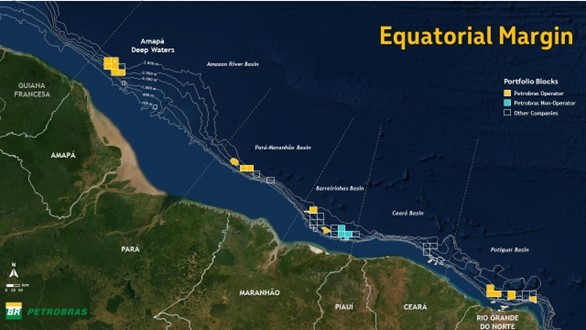
Nov. 10 (PN) The great potential to be discovered in the basins of the Equatorial Margin motivated Petrobras to undertake a long and arduous environmental licensing process with IBAMA (Brazilian Institute of Environment and Renewable Natural Resources). Having overcome this stage, the oil company is now beginning to face the technical and economic challenges. Currently, the state-owned company’s main bets are specifically on two areas: the well called Morpho, off the coast of Amapá, within the Foz do Amazonas Basin; and the Pitu Oeste and Anhangá wells, in Rio Grande do Norte, in the Potiguar Basin. Despite being promising, these wells will again require Petrobras’ already well-known technical capacity to explore resources in challenging environments.
In the case of the Foz do Amazonas Basin, this is the fifth deepest well in the company’s history. Furthermore, it is located in an exploratory frontier area, which requires additional caution during drilling, according to the company’s Exploration and Production Director, Sylvia Anjos. “It’s a pioneering well in a new area, so we’re taking extra precautions. The first pre-salt well took more than a year. Why? Because you proceed with utmost care, with all the uncertainties. That’s what a pioneering well is all about,” she explained.
Despite having already drilled a well in less than 40 days in the pre-salt layer, Petrobras will have to move more slowly in the Foz do Amazonas Basin. The initial estimate is that the drilling activity, which is being carried out with the ODN-II drillship, will last about five months. “The record for drilling a well in 35 days in the pre-salt layer is already for a fairly mature area. In five months, we will be in a pioneering well, in an area that goes to more than 7,000 meters deep, with a water depth of almost 3,000 meters, and with the largest column of rock drilled,” she stated.
The Director also highlighted that the work will require patience and precision, but did not rule out the possibility of completing the drilling in a shorter time than initially planned. “The rock column in this well is larger than the rock column we have in the pre-salt layer. So, all this requires more time, more phase changes. We think it could be a little sooner [than five months], but that’s a timeframe we see with more confidence,” she explained.
MORE COMPACT PLATFORMS
In the Potiguar Basin, the idea is to continue advancing with the drilling of a third well. Previous discoveries were important, but the volumes found do not yet justify investment in a production unit. The strategy, therefore, is to continue assessing the size of the reserves. “Now, with this third well, we will better assess the area’s potential and see which production unit can handle this volume.”
The executive said that the market, in general, has become very accustomed “to the billions of barrels of pre-salt oil.” However, Petrobras is now adjusting its strategy for new production scenarios. “We have to make an adjustment to have slimmer, more compact, production units for smaller volumes. This is a challenge that is presented to the teams, to [seek] other solutions,” she explained.
The Anhangá well is located near the border between the states of Ceará and Rio Grande do Norte, about 190 km from Fortaleza and 250 km from Natal, at a water depth of 2,196 meters, on the Brazilian Equatorial Margin. It was Petrobras’ second discovery in the Potiguar Basin, made in 2024. Previously, the company had already detected the presence of hydrocarbons in the Pitu Oeste well, located in the BM-POT-17 concession, about 24 km from Anhangá.
 Brazil Energy Insight
Leave a comment