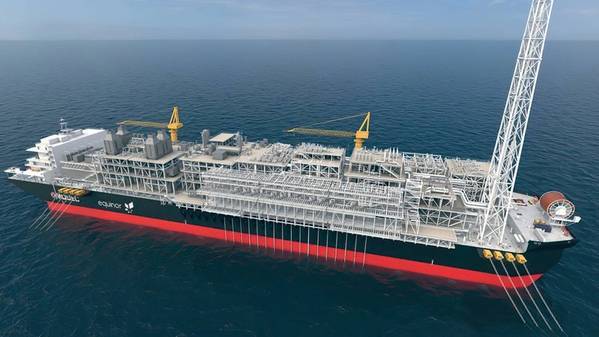
(PN) The Brazilian Institute of the Environment (Ibama) granted the preliminary license for oil and gas production activities at the Raia Project, operated by Equinor in the pre-salt layer of the Campos Basin. Also, the National Petroleum Agency (ANP) approved the construction of the 200 km gas pipeline that will connect the Raia FPSO to Cabiúnas, in Macaé (RJ).
The gas pipeline will start from the development area of the Raia Manta and Raia Pintada fields, located south of the Campos Basin, approximately 200 km off the coast of Rio de Janeiro, and will be interconnected to the Nova Transportadora do Sudeste (NTS) network in Macaé. A technical difference in the project is that all gas processing will be done at sea, eliminating the need for onshore facilities. This will be the first time in Brazil that gas will be specified in the offshore environment and delivered directly to the transportation system, thanks to the quality of the hydrocarbons extracted in the region.
The gas pipeline will total 204 km. Of this total, 200 km will be offshore, from the FPSO to its arrival on land, followed by approximately 4 km onshore, from the beach to the Gas Receiving Station in Macaé.
In addition to approving the construction of the gas pipeline, the ANP board also authorized the unification of the Raia Manta and Raia Pintada areas. According to the agency, the two fields are located in the same block and will share the same production unit. The ANP also highlighted that keeping the fields separate could result in lower government tax revenues. With the merger, the new field will be called simply Raia Mantada. Equinor will now have 60 days to present a development plan for the unified area.
Located in the Campos Basin, the Raia Project is operated by Equinor (35%), in partnership with Repsol Sinopec (35%) and Petrobras (30%). The asset comprises three pre-salt discoveries — Pão de Açúcar, Gávea and Seat — which together have recoverable reserves of natural gas and oil/condensate exceeding 1 billion barrels of oil equivalent (boe). The pipeline’s expected export capacity is 16 million cubic meters per day, a volume capable of meeting up to 15% of the country’s total gas demand when the project begins operations, scheduled for 2028.
 Brazil Energy Insight
Leave a comment