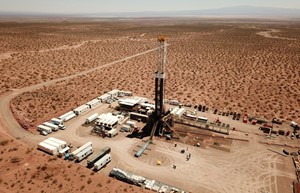
(oilprice.com) Despite the recent slump in international oil prices, YPF CEO Horacio Marín remains confident in the resilience of Argentina’s energy sector—particularly the viability of Vaca Muerta. Speaking to Infobae en Vivo, Marín stressed that YPF can sustain profitable operations even if crude prices drop to $40 or $45 per barrel. “We made ourselves resilient at less than $40 a barrel, and at $45 we can develop all of Vaca Muerta,” he said.
According to Infobae, YPF has shifted its strategy away from aging, less productive fields to focus on unconventional shale assets, positioning itself to compete directly with the Permian Basin in the U.S. Marín attributed YPF’s improved efficiency to years of local learning and the decision to concentrate resources where returns are strongest.
While private-sector analysts have warned that each $10 decline in oil prices could cost the Argentine energy industry up to $2.5 billion, Marín downplayed the threat to YPF. He acknowledged tighter margins, but emphasized that operations would remain cash-positive. The CEO did, however, flag access to financing as a more serious concern than oil prices. “If you want to issue a bond this week, it’s complicated,” he told Infobae.
Marín also highlighted the company’s long-term plan to quadruple its market value in four years—what he calls the “four-by-four” strategy. This includes eliminating infrastructure bottlenecks, digitizing operations, and scaling up LNG exports. Notably, YPF has only drilled 10% of its potential wells in Vaca Muerta and estimates over $200 billion in future investment opportunities.
As reported by Infobae, YPF is involved in a $3 billion crude pipeline project—Vaca Muerta Sur—the largest private infrastructure build in Argentina without direct government funding. The company is also advancing three LNG initiatives, including joint ventures with Shell, Pan American Energy, and others.
Marín concluded by reaffirming YPF’s autonomy under the current administration, stating that government leaders have not interfered with strategic decisions—a key factor, he said, in preserving YPF’s profitability in a volatile global market.
 Brazil Energy Insight
Leave a comment