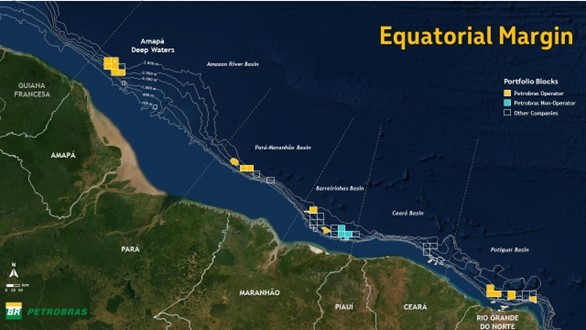
(Petrobras) The scientific community launched more than 428 drifters (equipment that measures the behavior of sea currents) on the Equatorial Margin, 84 of which are in the Foz do Amazonas basin. All confirm the studies and modeling carried out by Petrobras and approved by IBAMA in the environmental licensing of block FZA-M59. Studies have shown that sea currents headed in the opposite direction to the Brazilian coast.
Recently, the Ecological Characterization of Reef Systems of the Foz do Amazonas Basin project was started, which will generate new information. In this sense, research is being carried out through scientific expeditions aboard the ship Vital de Oliveira, within the scope of an existing cooperation between Petrobras, the Brazilian Navy, the Ministry of Science, Technology and Innovation (MCTI) and the Geological Survey of Brazil (SGB) . In June 2023, an oceanographic cruise was carried out in Amapá with the objective of identifying the occurrence of reef environments, which included detailed mapping of the seabed and the collection of samples to study the biological and geological composition of the bottom. The preliminary results are being published in a specialized journal for dissemination to the scientific community.
A second expedition will be carried out in the second quarter of 2024, continuing and deepening the scientific investigation. The expeditions expand collaboration with research groups in the country – especially from the states in the Equatorial Margin region, and include the participation of 29 researchers, from nine institutions, in addition to the Brazilian Geological Survey (SGB) and the Brazilian Navy. More than R$350 million has been invested from 2021 to 2028 in research projects, socio-environmental and monitoring projects associated with licensing and social responsibility projects in the Equatorial Margin states.
Blocks far from the coast
Petrobras does not intend to drill in coastal regions or close to sensitive areas. On the Equatorial Margin, the blocks are located far from the coast, in deep and ultra-deep waters. In the case of Block FZA-M59, the drilling of an exploratory well must occur at a distance of 160 km from the coast and more than 500 km northwest of the mouth of the Amazon River. Petrobras ratifies its commitment to science and the country.
It is also worth highlighting that Petrobras is a Brazilian company with over 70 years of experience. In the 1950s, the company began drilling the first wells in the terrestrial sedimentary basins of Amazonas and Solimões. In the 1970s, the first drillings were carried out in shallow waters in the Foz do Amazonas Basin. In this location, more than 70 wells were drilled by Petrobras. Furthermore, we have been drilling wells and producing oil and gas at the Urucu Pole, in the Amazon Rainforest, since 1988. All of these operations were and are carried out with complete safety and responsibility, in a sustainable manner and without harm to the environment.
The company has always worked to promote scientific development in the region in partnerships with scientific institutions. Still in the planning phase of activities in Urucu, Petrobras, in partnership with several institutions, developed guidelines for sustainable operations in the Amazon with renowned researchers. These guidelines were implemented and are still followed by the company today. A diversity of more than 1,500 species of flora and fauna were catalogued, promoting scientific knowledge about biodiversity in the Amazon.
In the past, two research and field data collection projects promoted by Petrobras in the Amazon region. The Piatam project, developed between 2000 and 2009, and the Environmental Knowledge Synthesis project – Strategic Areas of the Amazon, between 2012 and 2016. The projects had the participation of more than 10 research institutions in the region (COPPE, UFRJ, UFPA, UFMA, UEMA, Museu Paraense Emílio Goeldi, UFRA, CENSIPAM, IEPA, IEC, among others), 275 researchers, more than 55 published articles, 27 master’s theses, 7 doctoral theses, 15 equipped laboratories, 3 renovated research centers and aimed to collect integrated socio-environmental field data from the forest, the Amazon river complexes and the coastal, maritime and oceanic regions of the states of Amazonas, Amapá, Pará and Maranhão, encompassing 4 marine sedimentary basins on the equatorial margin.
Data such as fauna, flora, physical, chemical and geological oceanography, ecology and biological oceanography, mapping of sensitive areas, coastal ecology and data on socioeconomics and tropical diseases, among others, were collected in this work. It is important to highlight that within the scope of the Piatam project, the first computational models were developed to simulate the dispersion of fluids in the Amazon river complexes and in the seas and oceans of the equatorial margin.
After these megaprojects promoted by Petrobras, the industry carried out the Regional Environmental Study, through the companies BP, Total, Queiroz Galvão and, more recently, ENAUTA carried out the Costa Norte project, both collecting vast field data in the region.
Fossil sources will coexist with renewables in a low-carbon economy
For more than 200 years, since the pre-industrial revolution period, what has been observed is the process of diversification of the energy matrix to meet a growing global demand for energy. The challenge is to meet demand and expand access, reducing socioeconomic inequalities, energy poverty and ensuring energy security. The graph below illustrates the history of global energy consumption.
With the growth of the world population, industrial growth, technological development, the fourth industrial revolution underway (where systems that combine machines with digital processes, are capable of making decentralized decisions and cooperating – among themselves and with humans – through the internet of things) and the improvement in the population’s standard of living, it is expected that energy demand will continue to grow significantly.
Therefore, all energy sources will be strategic for supplying global demand. What will change is the relative participation of sources in the matrix, where we will see a more significant participation of renewable sources.
Therefore, the concept that Petrobras seeks is energy diversification, guaranteeing the supply of oil, but also seeking to invest in new energy.
New reserves in the context of energy diversification
The new oil and gas reserves are strategic for the country and essential for guaranteeing national energy security and sovereignty, in a scenario of energy diversification.
The remaining exploratory capacity in the pre-salt is already in decline. If Brazil maintains its oil demand at current levels and new reserves are not incorporated, the country runs the risk of becoming an oil importer by the end of the 2030s, and may need to import more than half of its oil demand. in the following decade. This would lead to a weakening of the country in terms of energy, resulting in dependence on external oil supplies and, consequently, leading to the loss of its energy security and sovereignty.
 Brazil Energy Insight
Leave a comment