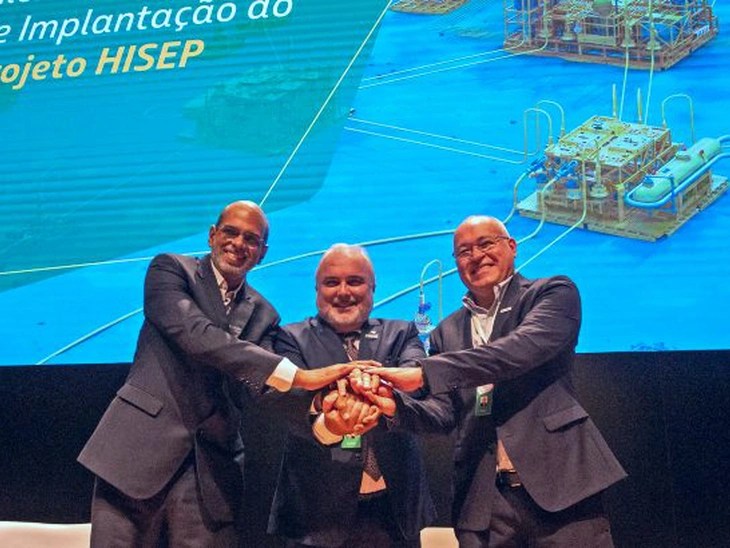
(TN)Petrobras announced the start of the contract for the development and implementation of HISEP®, an unprecedented technology patented by the company that will be used to increase production efficiency, reduce costs and the intensity of emissions in pre-salt oil and gas production systems. At the Petrobras Research, Development and Innovation Center (Cenpes), in Rio de Janeiro, the company’s president Jean Paul Prates, and the directors of Exploration & Production, Joelson Mendes, and Engineering, Technology and Innovation, Carlos Travassos, celebrated the beginning of the implementation phase of the HISEP® pilot project on a commercial scale. The Mero 3 project, located in the Brazilian pre-salt, will be a pioneer in the use of this technology.
HISEP® (acronym in English for High Pressure Separator) is a cutting-edge technology that revolutionizes the production process by enabling underwater separation between the extracted oil and the associated gas produced, rich in CO₂, which is reinjected directly into the reservoir from the seabed. In this way, a large part of the separation process is no longer carried out in the FPSO processing plant (floating unit that produces, stores and transfers oil) and is now carried out on the seabed, offering greater energy efficiency, reducing environmental impact and the intensity of emissions. This innovation is part of Petrobras’ RD&I portfolio and has the support of the company’s partners in the Libra Consortium.
“HISEP® is a Petrobras innovation, has Brazilian DNA and will soon contribute to the sustainable development of the gas oil industry. In addition to the gains for the business, it is a modern-day technology: one of its advantages is that it also acts as a carbon capture technology and, therefore, constitutes yet another tool that will help Petrobras achieve its reduction targets. the intensity of emissions”, declared Jean Paul Prates.
“HISEP® has the potential to add value to fields with high RGO (Oil and Gas Ratio) and CO₂ content, giving them a new production perspective. The choice of Campo de Mero for the pilot application of HISEP® is strategic, since the Santos Basin pre-salt is one of the most promising and challenging areas in the sector. With this revolutionary technology, we hope to optimize production, reduce costs and promote operational efficiency”, highlighted the Director of Exploration and Production, Joelson Mendes.
“The implementation of HISEP® represents a significant reflection of our continuous search for innovative technological solutions. This process is the result of years of research and development at Cenpes. We are confident that HISEP® will become a reference for innovation with gains in efficiency and generation of value in the oil and gas industry, contributing to consolidating Petrobras’ leadership position in the world market”, concluded the director of Engineering, Technology and Innovation, Carlos Travassos.
For this phase of HISEP® implementation, Petrobras signed a contract in January/2024 with FMC Technologies do Brasil, a subsidiary of the company TechnipFMC. This contract covers the design, construction and installation of the HISEP® pilot unit and its infrastructure, including interconnection with the production wells, injectors and the processing plant of the FPSO Marechal Duque de Caxias (Mero 3). In addition, a testing program will be carried out with the aim of reaching the commercial and technological maturity of HISEP®.
FPSO Marechal Duque de Caxias
The HISEP® submarine separation pilot unit will be interconnected to the FPSO Marechal Duque de Caxias, at the Mero 3 project, in the pre-salt area. This will be the fourth FPSO installed in the Mero field and will have a processing capacity of 180 thousand barrels of oil and 12 million m³ of gas per day. The charter and service contracts will last for 22 and a half years, counting from the final acceptance of the unit, scheduled for the second half of 2024.
The project foresees the interconnection of 15 wells to the FPSO, 8 of which are oil producers and 7 water and gas injectors, through a subsea infrastructure composed of rigid production and injection pipelines, flexible service pipelines and control umbilicals.
Mero Field
The Mero unitized field is the third largest in the pre-salt and is located in the Libra Block, belonging to the Libra Consortium, operated by Petrobras (38.6%) in partnership with Shell Brasil Petróleo Ltda. (19.3%), TotalEnergies EP Brasil Ltda. (19.3%), CNPC (9.65%), CNOOC Petroleum Brasil Ltda. (9.65%) and Pré-Sal Petróleo S.A. – PPSA (3.5%) which plays the role of manager of the Production Sharing Contract and representative of the Union in the non-contracted area.
 Brazil Energy Insight
Leave a comment