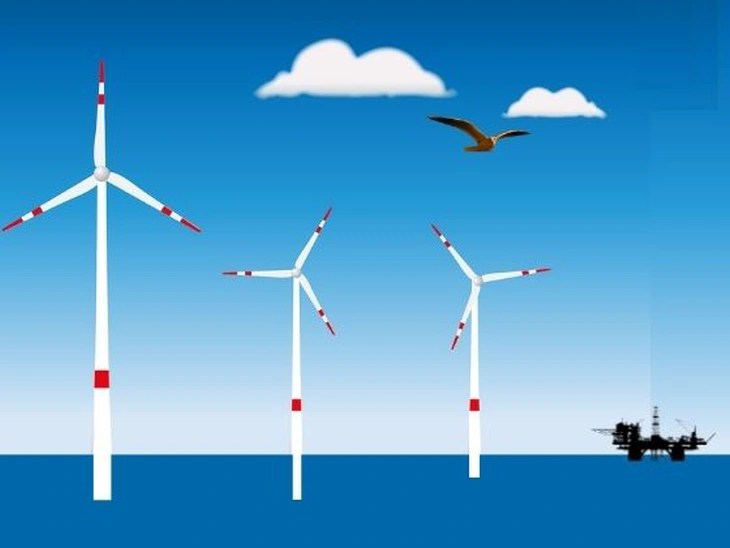
(PN) Petrobras, Shell Brasil, TotalEnergies, CNPC and CNOOC and the Federal University of Rio Grande do Sul (UFRGS) kicked off a series of studies that aim to map the offshore wind potential of the pre-salt region. The first data relating to the study is being collected in the Buzios field, and the work will soon be expanded to the Mero field – both located in the Santos Basin. The research is part of the Ventos de Libra Project, an investment of R$8 million that provides for the development of technology to carry out studies and create wind analysis methodologies, in addition to evaluating the technical feasibility of wind installations in the area.
“This is another initiative aimed at developing knowledge and training in the offshore wind segment, which has great potential in Brazil, this time with the involvement of important partners in the pre-salt and the academic sector, represented by renowned institutions”, declared the president of Petrobras, Jean Paul Prates.
The objective of the study is to collect unprecedented and high-quality information on the behavior of the region’s winds to support future offshore wind projects in the pre-salt. Wind information is crucial for determining the appropriate structure of wind turbines as well as describing the wind pattern in a given area. Furthermore, the project aims to promote scientific progress in wind modeling, data collection methodology, model optimization, and the reduction of uncertainties and risks for the implementation of floating wind projects in ultra-deep water areas.
The director of Energy Transition and Sustainability at Petrobras, Maurício Tolmasquim, highlights that “projects of this nature can indicate potential paths for us to continue advancing in the decarbonization of our activities, in line with what we have already announced in our Strategic Plan”.
The first wind measurement station was installed on the P-75 platform vessel, in the Buzios field. The data will be accumulated and transmitted directly from the platform to Petrobras’ Research, Development and Innovation Center, Cenpes, and will be evaluated over a period of 3 years. The project plans to install another piece of equipment in the Mero field.
“Measurement campaigns are nothing new for Petrobras. A decade ago, the company began feasibility studies for the implementation of offshore wind activity, with the installation of the first anemometric tower, capable of measuring wind characteristics, in the Brazilian sea on a platform installed in shallow waters on the coast of the state of Rio Grande do Sul. North”, recalls the director of Engineering and Technology and innovation at Petrobras, Carlos Travassos.
The Libra Consortium is operated by Petrobras (38.6%) in partnership with Shell Brasil (19.3%), TotalEnergies (19.3%), CNPC (9.65%), CNOOC (9.65%) and Pré-Sal Petróleo S.A. – PPSA (3.5%), which plays the role of manager of the Production Sharing Contract, in the Libra Consortium, and represents the Union in the non-contracted area. The Ventos de Libra project is led by two women: engineer Cristiane Lodi, who coordinates the project for Petrobras and the Libra consortium, and professor Adriane Prisco Petry, from UFRGS, who coordinates NIEPIEE (Center for Integration of Studies, Research and Innovation in Wind Energy).
 Brazil Energy Insight
Leave a comment