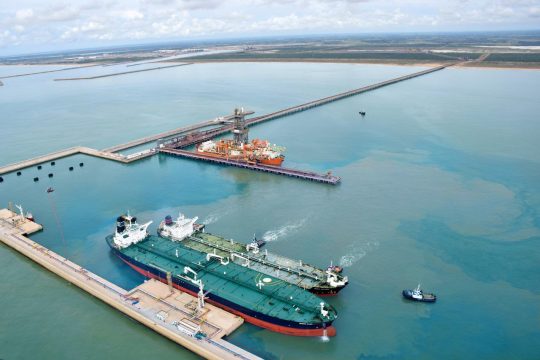
Porto do Açu, operated by Prumo Logística, celebrates a decade of operations in 2024. Located on the north coast of Rio de Janeiro, close to Petrobras’ rich pre-salt oil reserves, Porto do Açu stands out as the largest port-industry complex private sector in Brazil. Recently the complex has been venturing into new territories, with substantial investments in several projects. One of them is the surprising entry into the green hydrogen sector.
Expansion beyond oil and mining
Initially designed for the oil and gas sector, Porto do Açu has now established itself as a crucial hub for offshore oil exploration, with almost 38% of Brazil’s oil exports passing through its facilities. Under the management of Rogério Zampronha, CEO of Prumo Logística, the complex has consolidated itself as a vital center for the country’s economy, contributing significantly to 54% of the Southeast Region’s GDP.
However, Prumo Logística expanded its areas of activity, attracting investors and operators to different projects. One of the recent surprises was the entry of Porto do Açu into the agribusiness chain, with the export of non-transgenic soy and corn. The company plans to expand exponentially over the next 24 months, with the aim of becoming a relevant export port for the Brazilian agricultural sector.
Green energy is the focus of Prumo Logística’s investments
Prumo Logística’s main focus in the coming years is green energy. In August 2022, the company announced an investment plan of R$15 billion for the next decade, with a large part of this amount directed towards the energy transition. This includes the construction of a gas pipeline and a green briquette plant, HBI, as well as investments in biogas, biomethane and biofuels.
One of the highlights is the green hydrogen project, with Prumo starting the licensing of an area of 1 million m² in the port to create one of the largest clusters in the world, capable of producing 4 GW of hydrogen equivalent. The innovation includes the use of reused water, from the Anglo American pipeline, to produce hydrogen, an environmentally responsible and economical approach.
Competing on the global green hydrogen stage
Although other energy transition hubs, such as the Pecém Complex and the Camaçari Complex, are also emerging, the Port of Açu has its advantages. Its strategic location in the heart of the Southeast Region, responsible for 54% of Brazil’s GDP, places it in a privileged logistical position.
Furthermore, Porto do Açu has facilities that can house offshore wind energy projects, a crucial part of the energy transition. With the capacity to develop up to 34 gigawatts (GW) of offshore wind projects under licensing, the port becomes a relevant player in this market.
Challenges and ideal model
Despite the potential, Brazil faces challenges in the green hydrogen market, such as finding efficient ways to deliver it to large consumer markets. Transforming hydrogen into ammonia for export may not be the ideal solution, as it involves significant energy losses.
A more advantageous approach could be to attract industries to use hydrogen in Brazil and export processed products, such as HDI. This would reduce the costs of transporting the hydrogen itself and would place Brazil in a favorable position in the global energy transition market.
Porto do Açu, under the leadership of Prumo Logística, is committed to becoming a leading center in Brazil’s energy transition. With substantial investments in green hydrogen and an ambitious vision for creating a complete renewable energy chain, Porto do Açu is paving the way to a more sustainable and economical future for the country.
 Brazil Energy Insight
Leave a comment