
http://www.ft.com/cms/s/0/62207c4a-ec65-11e5-9fca-fb0f946fd1f0.html#ixzz43CKvOUsZ
March 17, 2016 5:48 pm
Judge’s bar on Lula puts Brazil on edge of constitutional crisis
Samantha Pearson in São Paulo
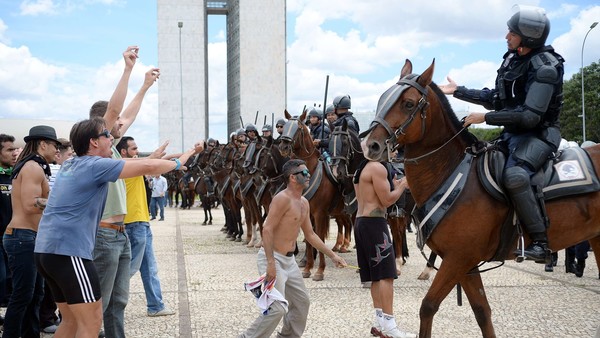
Brazil was teetering on the brink of a constitutional crisis on Thursday after a judge blocked President Dilma Rousseff’s appointment of her predecessor, Luiz Inácio Lula da Silva, to her cabinet, prompting clashes in Congress and on the streets.
Just as Mr Lula da Silva’s swearing-in ceremony drew to a close, a federal judge issued an injunction, suspending the ex-president’s appointment on the grounds that it prevented “the free exercise of justice” in corruption investigations.
Opposition politicians hailed the decision as a triumph for Brazilian democracy, while the government vowed to appeal, lambasting the order as part of a “coup” by the country’s elite, reminiscent of Brazil’s period of military rule. Brazilian assets rallied as investors bet on the government’s collapse.
“Since the end of the dictatorship and the transition to democracy over recent years, this is our most dramatic political moment — we have no idea what tomorrow will even look like,” said Gabriel Petrus, analyst at the consultancy Barral M Jorge Associates in Brasília.
The shouts of the coup plotters will not deter me and will not bring the nation to its knees
– Dilma Rousseff
Tweet this quote
“Dilma´s strategy of defence is attack and this risks creating social unrest and more violent demonstrations on the streets,” said Mr Petrus.
Mass protests swept the country on Wednesday night after a court released incendiary recordings of Mr Lula da Silva’s private conversations that fuelled accusations he had been appointed as minister only to shield him from immediate arrest. Military police fired tear gas at protesters outside the presidential palace following clashes with supporters of the Workers’ Party (PT), while demonstrators vandalised union and government buildings in some cities on Thursday.
State prosecutors requested Mr Lula da Silva’s arrest last week over charges of money laundering and fraud, accusing the former president of secretly owning a beachside penthouse at the centre of investigations into corruption at state oil company Petrobras.
The Supreme Court also published this week the plea testimony of senator Delcídio do Amaral, a Workers’ Party insider who was arrested last year, accusing Ms Rousseff and Mr Lula da Silva of being aware of the bribery and kickback scheme. Ms Rousseff, who is facing impeachment proceedings over separate allegations she broke budget laws, and Mr Lula da Silva have denied any wrongdoing.
Since the end of the dictatorship and the transition to democracy over recent years, this is our most dramatic political moment
– Gabriel Petrus, Barral M Jorge Associates
As a minister, Mr Lula da Silva would have immunity in all courts apart from the Supreme Court, which analysts said was more likely to act in his favour.
During the swearing-in ceremony of her mentor earlier on Wednesday, Ms Rousseff accused the opposition of plotting a coup against her government.
“The shouts of the coup plotters will not deter me and will not bring the nation to its knees”, she said as the cries of protesters could be heard outside the presidential palace.
While accustomed to political scandal, Brazilians reacted with shock on Wednesday night after Sérgio Moro, the federal judge leading investigations into Petrobras, released wiretaps of Mr Lula da Silva’s private conversations.
In the most explosive recording, Ms Rousseff called her mentor to tell him she was sending him a document confirming his ministerial appointment and that he should use it “only if it is necessary”, interpreted by the opposition as proof that the appointment was designed to protect him from arrest.
In other recordings, the ex-president is heard swearing and making light of the investigations in soundbites aired on television and radio that have gripped the country like one of its dramatic soap operas.
The government has accused Mr Moro, who has been heralded a hero across much of the country, of breaking the constitution.
Additional reporting by Carina Rossi in São Paulo
| Timeline of a scandal |
|
November 2007 Petrobras makes its first big “pre-salt” discovery off the coast of Rio de Janeiro, raising hopes Brazil will become an oil superpower August 2009 Petrobras announces plans to raise capital as part of a deal that increases the government’s stake in the company S eptember 2010 Petrobras raises $70bn in what is the world’s largest share offering January 2011 Ms Rousseff, who has served as Petrobras chairman since 2003, becomes Brazilian president August 2012 Petrobras posts its first quarterly loss in 13 years, partly as a result of the government’s refusal to allow it to raise fuel prices in line with global markets September 2013 Petrobras reports gross debts of more than $135bn, making it the world’s most indebted oil producer March 2014 Former Petrobras director Paulo Roberto Costa is arrested in connection with an investigation into allegations of corruption between from 2004 to 2012 April 2014 Brazil’s Supreme Court authorises a request for a congressional inquiry into alleged corruption at Petrobras. Ms Rousseff says Petrobras has become the target of a malicious political campaign S eptember 2014 After striking a plea-bargain with the authorities, Mr Costa names parliamentarians and other officials as being involved in the alleged corruption October 2014 Petrobras’s external auditor refuses to sign off on the quarterly results. Ms Rousseff wins re-election as president November 2014 Police in six states raid Petrobras offices and those of some contractors December 2014 Petrobras chief executive Maria das Graças Foster says she had offered to resign three times but Ms Rousseff had told her to stay on January 2015 Petrobras admits it is unable to calculate how much was stolen from it in the corruption scandal when it publishes its unaudited financial results. Some analysts had expected writedowns of up to $20bn February 2015 Ms Graças Foster and five other Petrobras executives resign. Multinationals are accused of participating in Petrobras corruption March 2015 Anti-government protests hit Brazil April 2015 Petrobras estimates its losses from the scandal at R$6bn, releases its 2014 financial results, averting technical default. International investors seek damages against the company June 2015 Top construction bosses, including Marcelo Odebrecht, arrested July 2015 Ex-president Luiz Inácio Lula da Silva faces criminal inquiry over business dealings overseas August 2015 Former aide to Mr Lula da Silva, José Dirceu, arrested. President Rousseff faces growing impeachment calls November 2015 André Esteves, CEO of BTG Pactual, arrested. Delcídio Amaral, leader in the senate of the Workers’ party, becomes first sitting senator arrested in Brazilian democratic history March 2016 Marcelo Odebrecht, one of Brazil’s most senior businessmen, sentenced to 19 years and four months over the corruption scandal Brazilian ex-president Luiz Inácio Lula da Silva detained for questioning and later charged in a parallel probe by state prosecutors, who request his arrest More than 3m protesters take to the streets. Ms Rousseff names Mr Lula da Silva as chief of staff |
Copyright The Financial Times Limited 2016.
 Brazil Energy Insight
Leave a comment