
Country’s best-known political figure fights to preserve his legacy and rally his party amid a welter of corruption allegations
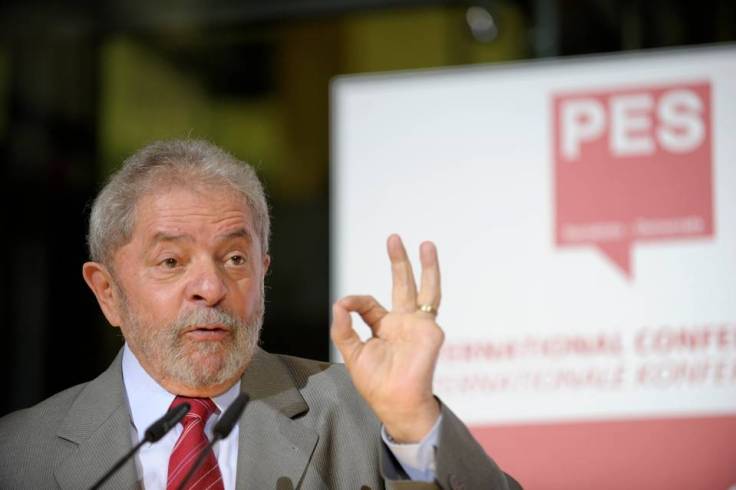
Mr. da Silva spoke earlier this month at a conference in Berlin. PHOTO: MARKUS HEINE/NURPHOTO/ZUMA PRESS
By
REED JOHNSON and ROGERIO JELMAYER/WSJ
Updated Dec. 29, 2015 5:29 p.m. ET
SÃO PAULO—Brazilians are hearing Luiz Inácio Lula da Silva do something he rarely did as president from 2003 to the beginning of 2011: admit mistakes.
The 70-year-old former union leader, still Brazil’s best-known and most charismatic political figure, is fighting to preserve his endangered legacy, thwart the impeachment of his handpicked successor, President Dilma Rousseff, rally his beleaguered Workers’ Party—and stay out of jail.
Mr. da Silva is being investigated for allegedly abusing his influence to help Brazilian construction giant Odebrecht SA obtain overseas contracts, allegations both he and the company deny.
But his biggest concern may be a separate corruption scandal centered on state-run oil giant Petróleo Brasileiro SA, or Petrobras. The widening investigation has enmeshed several of Mr. da Silva’s close friends and Workers’ Party allies, bringing the criminal probe steadily closer to Mr. da Silva and tainting Ms. Rousseff’s administration as well.
Neither Ms. Rousseff nor Mr. da Silva has been implicated in the so-called Operation Car Wash probe, and both deny any wrongdoing. But the inquiry has damaged the former president’s credibility and undermined the claim of his party, known as the PT, to hold the moral high ground in Brazilian politics.
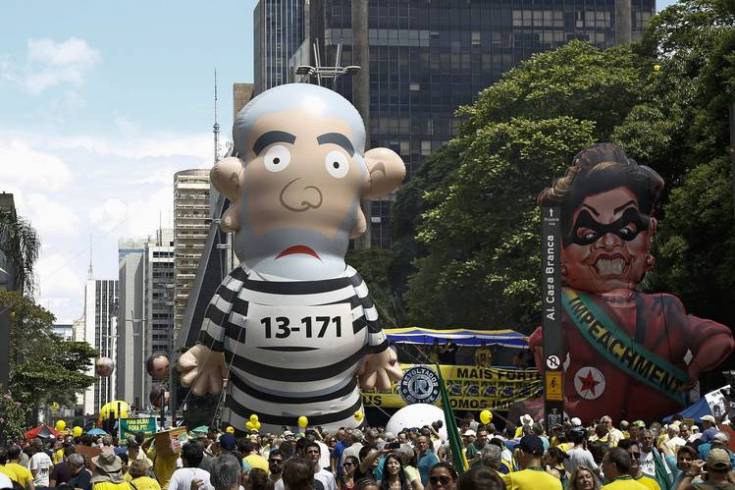
Demonstrators rally with giant balloons depicting Mr. da Silva, center, and his Workers’ Party colleague and successor, Brazilian President Dilma Rousseff, in São Paulo on Dec. 13. PHOTO: MIGUEL SCHINCARIOL/AGENCE FRANCE-PRESSE/GETTY IMAGES
“It’s gotten embroiled in all this corruption and it’s just become part of the system that it used to criticize,” said Anthony Pereira, a professor and director of the King’s Brazil Institute at King’s College, London.
Mr. da Silva, who declined to comment for this article, appears to recognize that public opinion has shifted against him and the PT. Even as his personal troubles have mounted and his popularity ratings have dipped, he has stepped up his public appearances to reconnect with voters and attempt to do damage-control for Ms. Rousseff.
“President Dilma is a manager and not a politician, so her political support depends a lot on Lula,” said Paulo Pimenta, an influential Workers’ Party congressman.
Mr. da Silva is far from a political has-been, and is even considering running for president again in 2018. But these days his manner is more contrite than cocksure. Many Brazilians blame the PT for mismanaging Brazil’s good fortune and driving the nation into its deepest downturn since the Great Depression. More than half of Brazilians polled in October said they would never vote for Mr. da Silva, a marked comedown for a president who left office with a record 83% approval rate.
“We committed mistakes,” Mr. da Silva recently told a Globo News television interviewer, referring to some of the PT’s economic strategies.
‘I know there are people who do not like us. I know there’s disagreement.’
—Mr. de Silva, at a recent rally in Salvador, Brazil
The PT leadership also has taken the brunt of the blame for a massive bribery-and-graft-ring at Petrobras that flourished on its watch. Prosecutors say that for at least a decade, company executives and suppliers conspired with politicians to skim money from inflated contracts at the oil firm and channel some of that money back to the Workers’ Party and its allies.
Mr. da Silva’s tarnished reputation has prompted public embarrassments that would have been unthinkable in the past. A giant balloon of him dressed in prison stripes has made frequent appearances at street protests. Demonstrators carry signs calling for his incarceration.
“I know there are people who do not like us. I know there’s disagreement,” he told a crowd a few weeks ago in the poor coastal city of Salvador, where he was booed by some in attendance.
Since then, the problems facing Mr. da Silva and his party have multiplied.
In late November, Sen. Delcídio do Amaral, a PT legislative whip and ally of Mr. da Silva and Ms. Rousseff, was arrested on suspicion of obstructing justice in the Petrobras investigation. Mr. do Amaral and investment banking mogul André Esteves are suspected of attempting to bribe a former Petrobras official to prevent him from supplying politically damaging testimony. Both men have denied wrongdoing.
Also arrested in November was cattle rancher José Carlos Bumlai, a close friend of Mr. da Silva’s, charged with corruption and money laundering in connection with the Petrobras scandal. Mr. Bumlai has denied wrongdoing.
‘They should send him to jail as soon as they can. ’
—Osvaldo de Barros, a São Paulo taxi driver and former supporter of Mr. da Silva
Mr. da Silva has been further vexed by authorities’ allegations that one of his sons, Luis Cláudio Lula da Silva, received illegal payments from a consulting firm that lobbied for tax breaks for Brazilian car manufacturers during his father’s administration and that of Ms. Rousseff. The younger Mr. da Silva has denied the allegations through his attorney.
Many Brazilians, including voters who once backed the PT, express growing disillusionment with the party and its signature politician.
“They should send him to jail as soon as they can,” said Osvaldo de Barros, 51, a São Paulo taxi driver who said he voted for Mr. da Silva twice.
Mr. da Silva still has strong support among Brazil’s poor and working-class constituencies, the main beneficiaries of his presidency. His social programs were widely credited with lifting tens of millions of Brazilians out of poverty.
Some believe any moves to arrest Mr. da Silva or impeach Ms. Rousseff could add to recession-wracked Brazil’s growing social unrest.
“Brazil is a powder keg, a pressure cooker, and any spark could make it explode,” said Guilherme Boulos, a leader of the homeless workers activist group called MOST.
Mr. Pereira, of King’s College, takes a less drastic view.
“I don’t think the party is so personalized that Lula being indicted or going to jail would decapitate the party,” Mr. Pereira said. “I think the structure of the machinery would carry on.”
Write to Reed Johnson at Reed.Johnson@wsj.com and Rogerio Jelmayer atrogerio.jelmayer@wsj.com
 Brazil Energy Insight
Leave a comment