
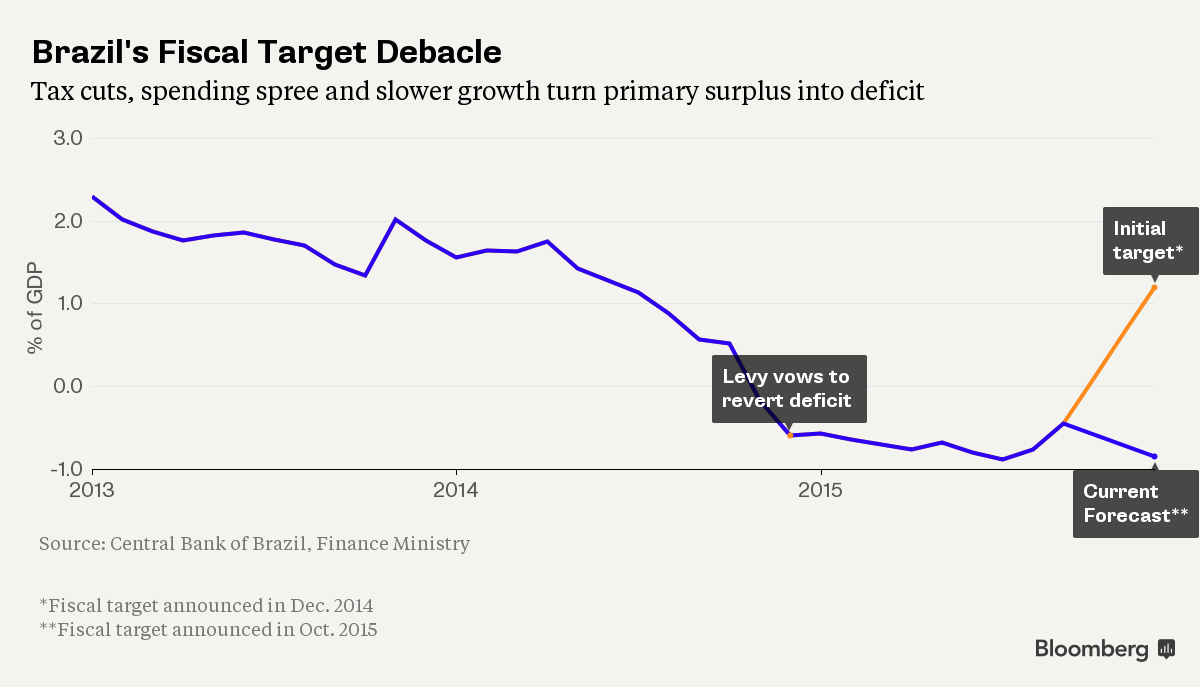
In Brazil, the push to oust President Dilma Rousseff has shifted, as often happens in politics, away from the corruption scandal that first landed her government in trouble. Impeachment calls are now focused on her handling of fiscal accounts, and that is perhaps fitting since few problems in Brazil rank higher than its exploding budget deficit.
At 536 billion reais ($141 billion), the gap has swollen to the equivalent of more than 9 percent of gross domestic product. It’s not just that the figure is the biggest in at least two decades; it’s how quickly it has grown as the country sinks into a protracted recession. Eighteen months ago, the deficit was 3 percent of GDP. So while no one is talking about default as a near-term concern — and bond yields show no such jitters — many do say that it’s helping fuel an inflation surge and could eventually push the country toward a full-blown debt crisis unless spending is reined in after a decade of largesse.
Caught in a grinding cycle of recession and eroding revenues, Brazil’s government finds itself in a damned-if-you-do-damned-if-you-don’t set of choices. In other words, while the country’s current debt dynamics look potentially unsustainable to UBS Securities LLC’s Geoffrey Dennis, he says that “if you try to cut a budget into a falling economy, chances are you’re not going to succeed.”


Leave a comment