
China Oil Industry, Experts Resist Proposal to Merge Companies
China’s leadership instructed a team of advisers to explore ways to revamp the energy sector
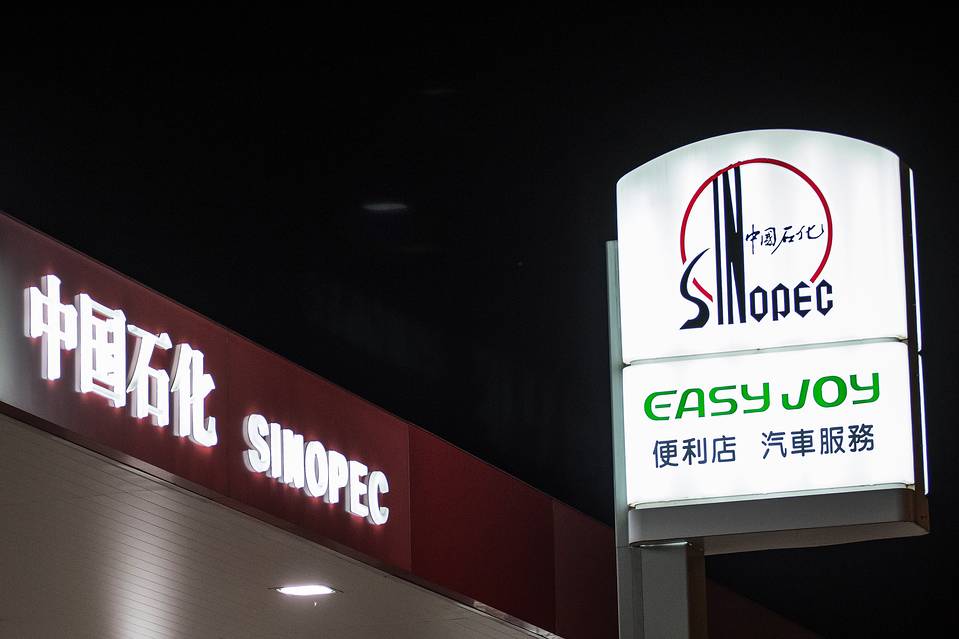
The Sinopec logo is illuminated at night at one of the company’s gas stations in Hong Kong, China, March 19, 2015. PHOTO: BILLY H.C. KWOK/BLOOMBERG NEWS
By
LINGLING WEI And BRIAN SPEGELE/WSJ
Updated May 4, 2015 8:07 a.m. ET
BEIJING—Chinese oil-industry officials and government advisers are pushing back against a proposal that could combine China’s already massive energy companies into new national champions, saying such a move would stymie competition and undermine Beijing’s effort to remake the economy.
The discussions, which are preliminary and ongoing, come as Beijing faces intense pressure to overhaul a vast state-controlled oil industry squeezed by falling energy prices. The merger discussions have met with skepticism from economists who say China needs more competition to nurture long-term growth and rebalance the world’s No. 2 economy.
In recent months, similar arguments have also been made by some Chinese oil officials, say experts and industry officials.
Meanwhile, Beijing on Monday began to shuffle the top heads of its biggest state oil companies, a widely expected move that nevertheless could add to the uncertainties the firms face. They include Fu Chengyu, China’s most famous oil man, known for leading a surprise 2005 Chinese bid for Unocal of the U.S., who on Monday retired as chairman of China Petrochemical Corp., or Sinopec.
Earlier this year, China’s leadership instructed a team of advisers to explore ways to revamp the sector, including potentially merging some of the country’s top oil producers and refiners.
Oil-industry executives are arguing that Chinese consumers would be better served by more market-driven reforms instead of government-driven consolidations, say people familiar with the discussions. “There is big pushback from the industry,” said one of those people, who is familiar with the deliberations at the state-owned Assets Supervision and Administration Commission, which oversees large state companies, including the oil giants.
Influential government advisers are also expressing skepticism. “Merging big oil companies would only lead to greater state monopoly and less inefficiency, and would be bad for consumers,” said Zhang Wenkui, a deputy director at the Development Research Center, a think tank affiliated with China’s cabinet, the State Council. “The bigger question now should be how to introduce more competition into the industry, not less.”

Fu Chengyu at a news conference in, Hong Kong, March 23, 2015. Mr. Fu on Monday retired as chairman of China Petrochemical Corp., or Sinopec. PHOTO: ALEX HOFFORD/EUROPEAN PRESSPHOTO AGENCY
Spokesmen for the oil companies and the agency, known as Sasac, declined to comment or didn’t respond to queries. Listed units for Sinopec and its main rival, China National Petroleum Corp., or CNPC, have said in recent filings they had received no information about a possible merger.
China’s oil companies have been reeling beneath the weight of plunging energy prices and President Xi Jinping’s sweeping corruption crackdown, which has seen more than two dozen senior oil executives put under investigation for graft and power abuses in the past two years.
One option being studied by the authorities involves combining CNPC and Sinopec, while others include merging China National Offshore Oil Corp., or Cnooc, and Sinochem Group, another major energy company. Bigger and stronger state companies, according to officials with knowledge of the discussions, are viewed by China’s leadership as key to the country’s reasserting its prominence in the world.
One big obstacle would be how to make the combined entities more efficient without reducing their bloated workforces—unattractive to the government at a time when maintaining jobs is a top priority. For instance, PetroChina Co., the listed arm of CNPC, has nearly 530,000 employees world-wide, a workforce more than seven times as large as that of Exxon Mobil Corp. The Chinese company delivered net profit of 107.17 billion yuan ($17.24 billion) last year, compared with $32.52 billion for Exxon.
A big challenge facing China’s big oil companies now, analysts say, is how to instill more financial discipline. The companies paid top dollar for assets around the world in recent years, but are in a rare pullback after oil prices lost about half their value. Both CNPC and Sinopec reported sharply lowered first-quarter earnings and are cutting capital spending.
The Chinese government may still decide to shake up the industry by forging some form of consolidation, according to Chinese officials and analysts.
“Xi Jinping likes to think big, and given the reversal in the oil sector’s political fortunes, we don’t think a reorganization of some kind can be ruled out,” said Rosealea Yao, an analyst at GavekalDragonomics. “Some combination of selective consolidation and greater liberalization, particularly in the less-strategic downstream business of refining and distribution, is the most likely outcome,” Ms. Yao added.
The 63-year-old Mr. Fu, of Sinopec, was succeeded as chairman by Wang Yupu, former vice governor of China’s northeastern Heilongjiang province. Mr. Fu led a $18.5 billion, ultimately unsuccessful bid for Unocal while he was running Cnooc.
Meanwhile, Zhou Jiping, retiring chairman of CNPC, China’s biggest oil producer by volume and revenue, is being succeeded by Wang Yilin, Cnooc’s chairman. A promotion for Mr. Wang to run CNPC solidifies his reputation as a rising star within the Chinese Communist Party. Cnooc’s $15-billion acquisition of Canada’s Nexen Inc. in 2013—the largest foreign takeover by a Chinese company to date—solidified Cnooc’s place on the global stage and has won its executives accolades from the government.
Yang Hua, currently general manager of Cnooc, will succeed Mr. Wang as the company’s chairman.
—Yang Jie
Write to Lingling Wei at lingling.wei@wsj.com and Brian Spegele atbrian.spegele@wsj.com
 Brazil Energy Insight
Leave a comment