
Brazil’s Turnaround Elusive as Tightening to Come Belies Rally
By Andre Soliani Costa Raymond Colitt / Bloomberg
12:00 AM BRT
May 1, 2015
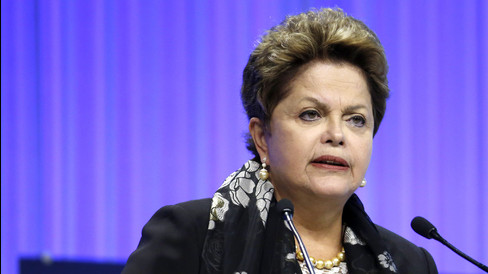
Brazil’s President Dilma Rousseff’s approval rating slumped 19 percentage points since December to 23 percent, the lowest level of any Brazilian president in 15 years, according to a poll conducted by Datafolha on Feb. 3-5. Photographer: Jason Alden/Bloomberg
April was kind to Brazil’s investors as the stock exchange entered a bull market and the currency rallied. Ordinary citizens didn’t fare so well: Unemployment rose to the highest in three years and interest rates surged to a six-year peak.
Signs that the economy is entering a recession and that policy makers will continue to tighten credit indicate that the road to recovery will be long, even as investors show renewed appetite for the country’s assets.
President Dilma Rousseff’s administration has pledged to do what it takes to narrow the budget gap, bring inflation to target and create conditions for state-run oil company Petrobras to return to bond markets. Keeping those promises may be hard, with Rousseff’s popularity at a record low, lawmakers balking at her economic policies and the economy headed for its worst contraction in 25 years.
“Brazil stepped back from the brink of collapse, but that doesn’t mean that it’s poised to rally,” Klaus Spielkamp, head of fixed income at Latin America-focused securities brokerage, asset management and investment banking firm Bulltick LLC, said by telephone from Miami. “The environment is still tough.”
The Sao Paulo stock index entered a bull market on April 24 after climbing 21 percent since its Jan. 30 low, with steelmakers Usinas Siderurgicas de Minas Gerais SA and Cia. Siderurgica Nacional SA among those leading the rally. The real rose 6 percent in April, the biggest increase among the 16 most-traded currencies tracked by Bloomberg after the Norwegian krone.
Investors Flocked
Rising commodity prices and expectations that the U.S. Federal Reserve will delay interest-rate increases fueled the gain in assets. Foreign investors also flocked to Brazil after its state oil company, known formally as Petroleo Brasileiro SA, reported its first audited results since August and Rousseff picked the party chief of her biggest coalition partner to lead negotiations with Congress.
Investors may leave as quickly as they came, said Bernd Berg from Societe Generale in London. Interest rates in the U.S. eventually will rise and Brazil’s government may fail to shrink the budget fast enough to appease credit-rating companies. The threat of a downgrade increased last month when Fitch Ratings cut Brazil’s credit-rating outlook to negative, citing challenges in filling government coffers amid a stalled economy.
‘Rapidly Exit’
“These investors rapidly exit Brazil assets again on the first signs of trouble,” said Berg, director of emerging-markets strategy at the French bank. “Growth and inflation data must improve significantly to attract longer-term capital inflows.”
Traders aren’t optimistic that central bank President Alexandre Tombini will succeed in bringing consumer-price increases to the 4.5 percent target. Even after policy makers raised interest rates on April 29 for the fifth consecutive meeting, the bond market’s outlook is for a 6.19 percent jump in the cost of living in a year.
The central bank signaled in its latest decision it will lift benchmark borrowing costs for a sixth time in June after inflation in mid-April surged to more than a 10-year high.
With interest rates stoking credit-card bills and prices on things from electricity to clothing surging, consumption has faltered. Auto production in March fell 7 percent from a year earlier, contributing to a 50 percent decline in MAN SE’s first-quarterearnings as the German truck manufacturer said South American orders dropped.
Worst Performance
Such dynamics have led analysts surveyed by the central bank to forecast a 1.1 percent drop in gross domestic product this year, which would be the worst performance since 1990.
The presidential press office didn’t respond to an e-mail sent after business hours seeking comment on Brazil’s economic outlook.
The slowdown is eroding tax revenue at a time when Finance Minister Joaquim Levy says he needs to narrow a budget deficit that threatens Brazil’s investment-grade status. The deficit expanded to 7.8 percent of GDP in the 12 months through March.
Levy cautioned lawmakers on April 29 that the risk of a downgrade will “return fast” if Brazil fails to implement measures to contain spending and raise revenue.
Senate President Renan Calheiros a day later said the government is forcing workers to pay the price for Levy’s austerity policies, which include legislation to cut unemployment and pension benefits.
Venting Discontent
“This can’t even be called a fiscal adjustment,” Calheiros, a member of Rousseff’s alliance in Congress, told reporters in Brasilia. “The fiscal adjustment needs to cut the fat, reduce the number of ministries and political appointments. Without that, it’s an adjustment for workers.”
More than two million Brazilians in March took to the streets to vent discontent over the deepening economic malaise and government graft. In the country’s largest-ever corruption scandal, federal police are investigating allegations that a cartel of construction companies fixed bids on Petrobras contracts and bribed executives during a span stretching back to when Rousseff was the oil company’s chairman.
The president’s popularity is at a record-low 13 percent as the majority of Brazilians support impeachment proceedings against her, according to an April 9-10 poll by public-opinion research company Datafolha.
With Rousseff’s own political survival in doubt, it won’t be easy to rally support in Congress and on the streets for unpopular measures that investors say are needed to put the economy back on track, said Christopher Garman, head of country analysis at political-risk consulting firm Eurasia Group.
“The president isn’t out of the woods just yet,” Garman said in a phone interview from Washington. “It’s still a precarious environment. It would be a mistake to look at recent developments as a true sign that the administration is on firmer footing.”
 Brazil Energy Insight
Leave a comment