
http://www.ft.com/cms/s/0/48eb2bfa-e3ea-11e4-b407-00144feab7de.html#ixzz3XVDLePJM
April 16, 2015 4:49 pm
Dilma Rousseff accused of ‘outsourcing’ top government posts
Joe Leahy in São Paulo/FT
Crisis-hit Brazilian president weighs benefit of giving up control of key roles
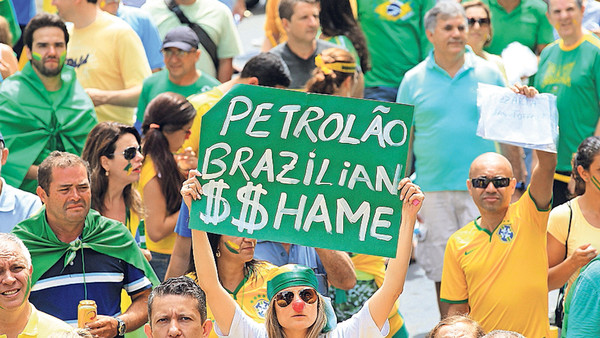
©EPA/Sebastiao Moreira
Demonstrators protest in São Paulo over the Petrobras scandal
T
he atmosphere at São Paulo’s mass political protests against President Dilma Rousseff’s government was carnival-like. Demonstrators on Avenida Paulista, the Brazilian city’s main thoroughfare, sipped beers and listened to speeches and music blaring from trucks at last Sunday’s rallies.
But Abraão Alberto and his companions from the Nationalist Democratic Union, a rightwing political organisation, stood out. Clad in military fatigues, they hoisted placards supporting heroes of the right such as “Grandpa Shrapnel”, alias Carlos Alberto Augusto.
Their homage to the former agent for Brazil’s secret police under the previous military dictatorship stems from their longing for the perceived order of army rule, which lasted for two decades until 1984.
“I had a great education during the military period. I could live in peace, I could sleep with my windows open, I can’t do that any more,” said Mr Alberto, lamenting what he sees as the rise of political corruption and street crime since the country returned to democracy.
Far-right protesters such as Mr Alberto might occupy the fringes of contemporary Brazilian politics, but they have one thing in common with the wider population — they support an impeachment of Ms Rousseff.
The president`s popularity is suffering amid a flagging economy and a corruption scandal at the state-controlled oil company Petrobras that is undermining her ruling Workers’ party (PT).
In one of the most dramatic moments yet in the scandal, in which former Petrobras officials are accused of conniving with politicians to cream off kickbacks from the company, the PT’s treasurer, João Vaccari Neto, was detained by federal police on Tuesday as he was about to go for his morning run.
“Three in every four Brazilians support the protests against the government,” said the poll company Datafolha. “A majority of Brazilians [63 per cent] believe that the national congress should open an impeachment process to remove Dilma Rousseff.”
But while the Petrobras scandal will continue to make the headlines, there are signs that, in other areas, the atmosphere of crisis that has plagued the first 100 days since the start of Ms Rousseff’s second four-year term in January may be easing slightly.
On the political front, she began the term in open conflict with congress, with her main coalition partner, the centrist PMDB, demanding more power after trumping the PT in last year’s elections to become the dominant party in the lower house.
Petrobras timeline
March 2014: Former Petrobras director Paulo Roberto Costa arrested on money-laundering charges. His plea bargain reveals much larger bribery and kickback scheme at the oil company.
November 2014: Executives from top Brazilian construction groups arrested afteraccusations they conspired with Petrobras executives to cream off billions of dollars.
February 2015: Petrobras chief executive Maria das Graças Foster resigns. Moody’s downgrades Petrobras’s credit rating to junk status after auditors refuse to sign off accounts.
March 2015: Supreme Court says it will investigate more than 30 congressmen and senators. More than 1m people protest over scandal.
April 2015: Mass protests in São Paulo. PT treasurer João Vaccari Neto detained by federal police.
The speakers of the lower house and the senate respectively, Eduardo Cunha and Renan Calheiros — both from the PMDB — kicked off the year by rejecting legislation proposed by the president, including important fiscal tightening measures. This prompted fear among markets that Brazil might be unable to meet promises to curb an exploding budget deficit that is putting its investment-grade credit rating at risk, and pushed the currency, the real, to a new 10-year low against the dollar.
This month, however, the president held out an olive branch to her coalition partners by handing responsibility for political co-ordination between the presidential palace and congress to Michel Temer, her PMDB vice-president.
The move sparked opposition criticism that the president was “outsourcing” politics to the PMDB. “Today, President Dilma is no longer the one who governs Brazil,” said Aécio Neves, leader of the centre-right PSDB party.
João Augusto de Castro Neves, a Eurasia Group analyst, said: “It’s a sign of the weakness of Ms Rousseff.”
Opposition claims that the president is outsourcing the most important functions of government have been boosted by the rising profile of Joaquim Levy, the new finance minister.
A fiscal hawk brought in from the private sector to replace the PT stalwart Guido Mantega, the Chicago-trained economist is unwinding the fiscal largesse and statist policies that characterised Ms Rousseff’s first term.
Mr Levy is seen in markets as autonomous and as Brazil’s best hope of restoring its budget balance. Most analysts believe that any attempt by Ms Rousseff to dictate policies to him could result in his resignation and lead to a run for the exits by investors.
“He is the canary in the coal mine,” said Alexandre de Azara, chief economist of Modal Asset Management in São Paulo. “He cannot be taken away without creating a [market] collapse.”
Mr Levy also appears able to negotiate with the PMDB, which broadly supports the fiscal adjustment. “I think Levy is going to be strengthened by [Vice-president] Temer`s new role,” said Paulo Sotero, director of the Brazil Institute at the Woodrow Wilson International Centre for Scholars.
The perceived outsourcing is reducing Ms Rousseff`s own room for manoeuvre, only three months into her second term, although the PT retains control over foreign policy. A meeting with President Barack Obama is set to be held in Washington at the end of June.
But it will also leave her more time to deal with Petrobras and the protest movement. While Sunday’s demonstrations were not as big as a month earlier, when more than 1m turned out across Brazil, public indignation over the Petrobras scandal is not going away.
“We want order and progress,” said Mr Alberto. “We don`t want corruption, banditry and organised crime.”
Copyright The Financial Times Limited 2015
 Brazil Energy Insight
Leave a comment