
Oil Rises to Three-Month High
By Mark Shenk/Bloomberg
11:38 AM BRT
April 15, 2015
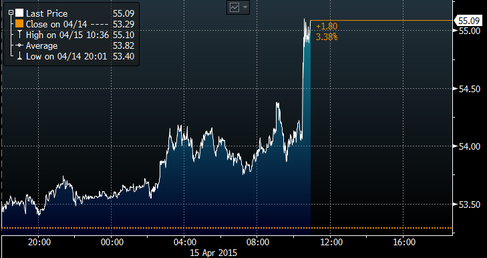
Oil surged to the highest this year as a pause in the U.S. shale boom was seen easing the biggest supply glut since 1930.
Crude supplies increased last week at the slowest pace since January, according to the Energy Information Administration. Output from shale formations such as North Dakota’s Bakken will fall in May, the EIA said Monday.
A near 50 percent plunge in prices since the middle of last year has forced half the country’s drilling rigs offline and wiped out thousands of jobs. U.S. refineries have boosted operations, processing a record amount of crude for this time of year.
“We’re at the cusp of a major change,” Matt Sallee, who helps manage $17.7 billion in oil-related assets at Tortoise Capital Advisors in Leawood, Kansas, said by phone. “Production is stabilizing and set to move into decline faster than people expected.”
West Texas Intermediate for May delivery increased $2.61, or 4.9 percent, to $55.90 a barrel at 12:54 p.m. on the New York Mercantile Exchange. Futures reached $56.03, the highest level since Dec. 26. Volume was 80 percent above the 100-day average for this time of day.
Brent Market
Brent for May settlement, which expires Wednesday, climbed $1.37, or 2.3 percent, to $59.80 a barrel on the London-based ICE Futures Europe exchange. The more active June contract gained $2.64, or 4.4 percent, to $62.45. Volume was up 20 percent from the 100-day average. The European benchmark crude traded at a $4.35 premium to WTI.
U.S. crude supplies climbed 1.29 million barrels to 483.7 million last week, the highest level in records compiled by the EIA since August 1982. Monthly data going back to 1920 show stockpiles haven’t been this high since 1930. Inventories were projected to climb 3.6 million barrels, according to the median of 10 analyst estimates in a Bloomberg survey.
“The supply gain was a lot smaller than what we’ve gotten accustomed to so the report is bearish even though inventories are at the highest level in more than 80 years,” John Kilduff, partner at Again Capital LLC, an energy hedge fund in New York, said by phone. “The big drop in gasoline is also supportive, since it’s the seasonal leader.”
Record Supplies
Inventories at Cushing, Oklahoma, the delivery point for WTI traded in New York, climbed 1.29 million barrels to a record 61.5 million.
Crude production fell 20,000 barrels a day to 9.38 million last week, according to the EIA. That’s down from 9.42 million on March 20, the most in weekly estimates that started in January 1983. Output has surged as the combination of horizontal drilling and hydraulic fracturing, or fracking, unlocked supplies from shale formations in the central U.S.
Output from shale formations such as North Dakota’s Bakken will fall 57,000 barrels a day in May, the EIA said Monday. Deutsche Bank AG, Goldman Sachs Group Inc. and IHS Inc. have projected that U.S. oil production growth will end, at least temporarily, with futures near a six-year low.
Refinery Activity
Refineries operated at 92.3 percent of their capacity, up 2.2 percentage points from the prior week, the report showed. U.S. refiners schedule maintenance for late winter as they transition from winter fuels to maximizing gasoline output.
Refineries used 16.5 million barrels a day of crude and other liquids last week, the highest seasonal level in weekly data going back to 1989.
“Refineries are coming out of seasonal maintenance,” Sallee said. “We’re seeing a nice trend of growing refinery utilization rates that will help move the domestic crude market into balance.”
Supplies of gasoline fell 2.07 million barrels to 227.9 million, the lowest level since December. Inventories of distillate fuel, a category including diesel and heating oil, rose 2.02 million barrels to 128.9 million.
Gasoline futures for May delivery rose 6.79 cents, or 3.7 percent, to $1.9039 a gallon. May ultra low sulfur diesel climbed 6.41 cents, or 3.6 percent, to $1.8658.
OPEC production rose the most in almost four years in March, the International Energy Agency said Wednesday in a report. Output grew by 890,000 barrels a day to 31.02 million a day, the biggest monthly gain since June 2011, the Paris-based IEA said. The group’s 12 members, which pump about 40 percent of the world’s oil, are scheduled to meet June 5 in Vienna.
“OPEC’s core Gulf producers — led by Saudi Arabia — appear to be sticking with their defense of market share,” the IEA said Wednesday in its monthly market report.
The IEA lowered its prediction for North American oil production in the second half of the year by 160,000 barrels a day. That’s partly because of a weaker outlook for the U.S., where drillers have cut the number of rigs in service to the lowest since 2010, according to Baker Hughes Inc.
 Brazil Energy Insight
Leave a comment