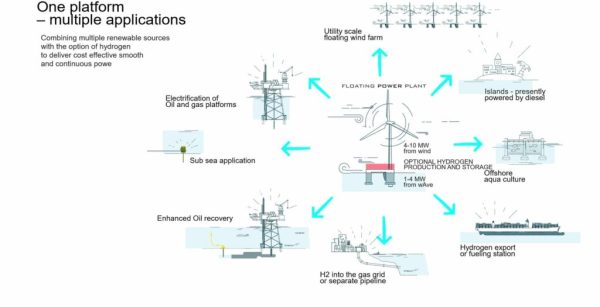
Taking the power to where you want it is another option – perhaps not for compression or pumping system, but potentially for monitoring, inspection, and even intervention systems, such as resident robotics concepts. It’s an idea some have been looking at, such as Ocean Power Technologies, which recently won a DeepStar project award to study... Continue Reading →
Sevan SSP Works on Cylindrical Floating Wind Foundation Design
Sevan SSP, a company designing cylindrical, offshore facilities such as FPSOs and offshore rigs, has entered the floating wind game with its SWACH design. "Sevan SSP is happy to announce our participation in the development of floating offshore wind energy with our Sevan Wind concept, the SWACH design," the company, a subsidiary of Singapore-based Sembcorp... Continue Reading →
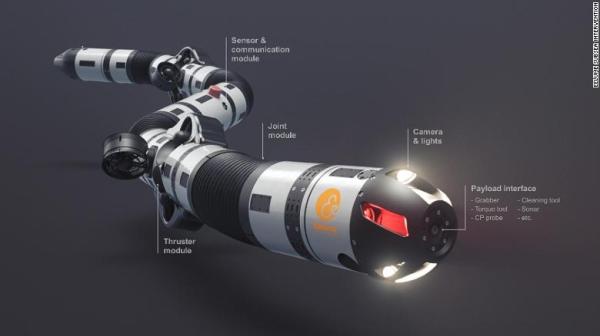
Saipem trials FlatFish subsea drone
Saipem has started the functional tests of FlatFish, the innovative underwater drone for advanced vessel free subsea inspections, based on AI. According to the company, the vehicle is now going to an extensive sea trial campaign. Since March 2018, Shell has been entrusting Saipem with the license to develop the FlatFish technology and qualify it... Continue Reading →
Putting Power on the Seabed: Edging towards a Subsea Powerhouse
Ten years ago, a future where subsea fields and their power-hungry process equipment could be fully electrified, enabling long step-outs to tap remote reserves with lean new infrastructure architectures, lit the fuse for a spate of investment in subsea power distribution.The result, following at least two major joint industry projects (JIP) and tens of millions... Continue Reading →
Baker Hughes Flexible Pipe: Reinventing the Familiar for Subsea Production
In 2017, the Brazil National Petroleum Agency (ANP) issued a failure mode alert: stress corrosion cracking (SCC-CO2) triggered by the presence of CO2 in high-pressure pre-salt conditions had been identified as the cause of broken tensile armor wires on a certain flexible pipe installation. Relatively common in other applications where carbon steel is subject to... Continue Reading →
MODEC develops new offshore repair method for FPSO hulls
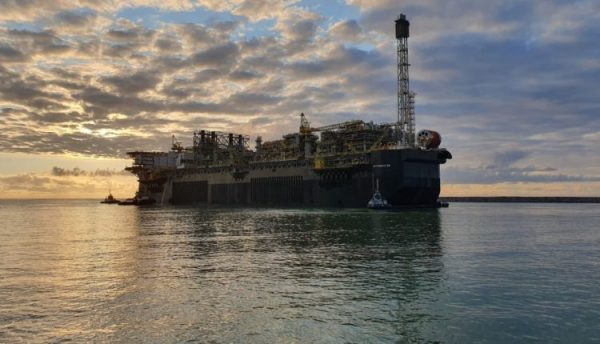
Japan’s FPSO specialist MODEC in December 2020 obtained approval by the American Bureau of Shipping (ABS) for the new offshore repair method for hull structures of floating oil and gas production facilities such as floating production storage and offloading (FPSO) vessels as an original standard repair method. Diagram of new offshore repair method; Source: MODEC... Continue Reading →
Petrobras receives super computer
Petróleo Brasileiro S.A. – Petrobras informs that it has started to receive the equipment that compose the supercomputer called “Dragon”, a high performance computer aiming at a greater geophysical processing performance, reducing geological and operational risks. Petrobras has increased investment in high-performance computers and, in less than two years, it has put into production nine supercomputers,... Continue Reading →
Offshore Oil’s Dramatic Comeback
Smack dab in the middle of an oil price crisis caused by an unprecedented demand loss, Exxon announced the latest in a string of discoveries off the eastern South American shore, this time in Suriname. It must have felt like adding insult to injury for OPEC producers and reckless behavior for investors, but offshore oil... Continue Reading →
OIL TANKER EAGLE PASSOS ON THE ITS TO BRAZIL TO STRENGTHEN THE TRANSPETRO FLEET
The oil tanker Eagle Passos, a vessel of the AET company, has already departed for Brazil and will reinforce the Transpetro fleet. The new unit left the Samsung Heavy Industries shipyard in South Korea and is expected to dock in Rio de Janeiro around the 11th of next month. Eagle Passos is the latest in... Continue Reading →
What’s In Store for 2021? More Remote, More Data, More Autonomy
Late 2018, before net-zero targets had been agreed to by most western energy giants and nations, BP came out with a goal to reach 100% of subsea inspection by marine autonomous systems by 2025. It was a tangible goal then, and it’s one that might now be reached faster as remote and more “digitally” oriented... Continue Reading →