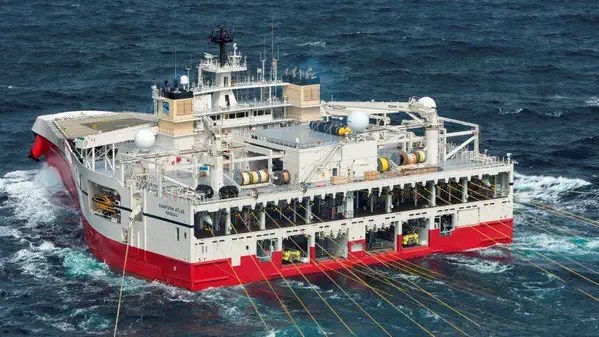
Dec. 1 (TN) TGS began, this Saturday (November 29th), 3D marine seismic survey in the Pelotas sedimentary basin, Pelotas Norte Phase I program, 96 kilometers off the coast of the municipality of Laguna, in Santa Catarina, between the municipalities of Florianópolis and Palmares do Sul, at depths greater than 200 meters. The research area was licensed in October by IBAMA (Brazilian Institute of Environment and Renewable Natural Resources) and has authorization from the Brazilian Navy and the National Petroleum Agency for execution.
Phase I will cover 14,800 km² distributed across 21 exploration blocks, most of which are located in unlicensed areas that should be included in the next bidding rounds.
“Exploration activity in the Pelotas Norte Basin is accelerating, with major oil companies increasing their presence and commitment to exploratory investments in the area. The Pelotas Norte Phase I multi-client survey significantly expands our seismic coverage. By leveraging our advanced acquisition resources and imaging expertise, this survey will help our clients better understand the basin’s geological structures and reduce the risk of future exploration activities,” highlights João Correa, TGS country manager in Brazil.
The survey will be conducted by the seismic vessel Ramform Titan, accompanied by the vessels Ocean Mermaid, C Itajaí, and DRS Ipanema. The position of the vessel and support vessels is being reported daily to fishing communities, federations, and fishermen’s unions in the region.
According to the executive, following the announcement of two major multi-client research projects in the Equatorial Margin at the beginning of the 3rd quarter, the addition of Pelotas Norte Phase I brings to three the number of Ramform-class vessels working offshore in Brazil for the remainder of this year and into next year (Ramforms Titan, Atlas, and Tethys).
Science and Biodiversity
As a counterpart to the environmental licensing conducted by IBAMA, in addition to the mitigation and monitoring programs for environmental impacts, TGS’s research in the Pelotas Basin will enable an important study on the region’s marine biodiversity. This study will integrate analyses of organisms from the base of the food chain (phytoplankton, zooplankton, small pelagic fish) to top predators (cetaceans and seabirds), along with oceanographic variables and using various cutting-edge methodologies, such as telemetry, environmental DNA, drone monitoring, acoustics, and sample collection.
According to João Correa, together, the seismic research and the biological program constitute what will likely be the largest integrated biodiversity initiative ever undertaken on the Brazilian continental shelf, combining the exploration of a new frontier with robust and transparent environmental science.
“More than a technical step, this represents strategic progress: advancing geological knowledge of the Pelotas Basin and supporting future exploration, while expanding our understanding of marine ecosystems in southern Brazil. This is just the beginning. A new horizon of exploration is opening up,” says the executive.
 Brazil Energy Insight
Leave a comment