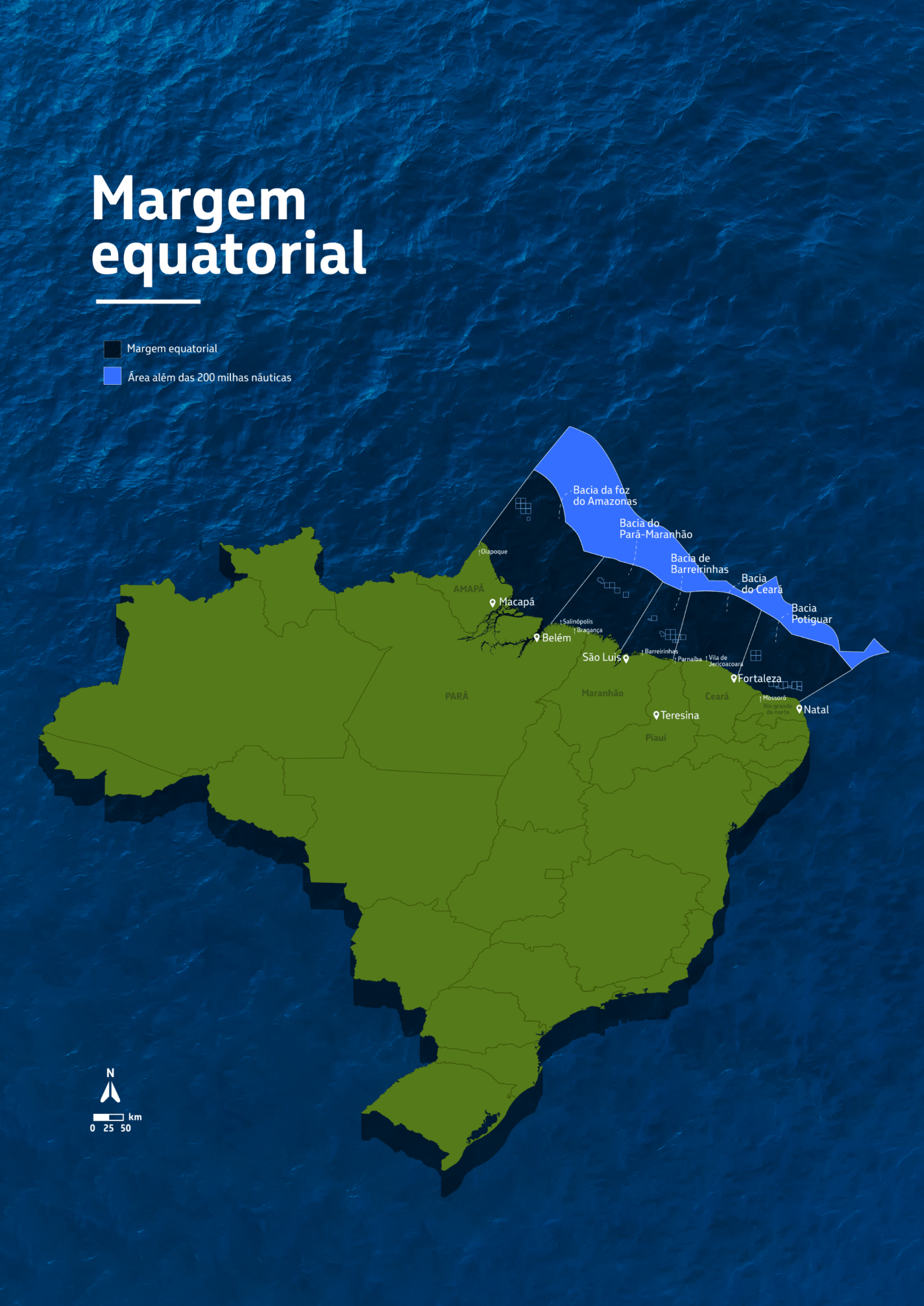
A comprehensive effort to acquire and interpret geological and geophysical data from the entire Brazilian continental margin, conducted by Petrobras professionals over decades, contributed to a major diplomatic and economic achievement for the country: the expansion of the limits of the continental shelf beyond 200 nautical miles, from the baselines located on the coast in the North region, in accordance with the United Nations Convention on the Law of the Sea (UNCLOS). Previously, Brazil’s outer limit was 200 nautical miles, as provided for any coastal state signatory to the Law of the Sea. With the publication of the Summary of Recommendations of the Commission on the Limits of the Continental Shelf (CLCS) regarding the Revised Partial Submission for the Equatorial Margin on the official UN website, Brazil’s sovereign rights were expanded by approximately 360 thousand km2. To give you an idea, this area is equivalent to the territory of Germany. The decision granted Brazil the right to explore the natural resources present on the seabed and sub-seabed in this new region.
“For Petrobras, it is a source of immense satisfaction and honor to have researchers who worked with the Brazilian Navy teams in this process with the UN. We know how important the decision to expand the maritime area is for Brazil. In addition to strengthening the country’s sovereignty, it allows access to the resources present there. The partnership between Petrobras and the Navy has been going on for a long time, and this is yet another historic result of this joint effort,” says Petrobras’ Director of Exploration and Production, Sylvia Anjos.
The UNCDN recognizes that countries may extend their maritime limits beyond 200 nautical miles, provided that they present technical and scientific studies that prove the extension of their continental shelf beyond this limit, respecting the criteria set forth in the Convention. The technical rule consists of determining, based on geomorphological parameters of the seabed and sediment thickness, the extent to which there is a natural extension of the submerged continental mass.
The studies supported the work of members of the Leplac Project (Continental Shelf Survey), conducted by Navy professionals with the participation of dozens of Petrobras technicians, who were involved in the acquisition, processing, interpretation and integration of geophysical, geological and geochemical data from the entire continental margin of the Brazilian coast and, in particular, from the Brazilian Equatorial Margin. The results of the activities and work carried out by these professionals were consolidated in technical reports and articles presented at conferences and published in specialized journals. These studies are evaluated with great rigor, in a long process of analysis, considering compliance with the specifications defined by the recommendations of the UN Limits Commission.
These geological characteristics served as a basis for determining the external limits and the expansion of our continental shelf, on the coast of the Brazilian Equatorial Margin.
Historical: how this movement began
This movement began in the 1980s, when Brazil signed the UN Convention on the Law of the Sea – better known as the “Law of the Sea”. The Brazilian government then created the Brazilian Continental Shelf Survey Plan (LEPLAC), coordinated by the Interministerial Commission on Sea Resources, led by the Navy.
In 1987, the company’s teams of geologists and geophysicists began a broad “x-ray” of the subsoil of the entire Brazilian coast – which involved the acquisition, processing and interpretation of geophysical and geological data, in addition to significant computing capacity and applied technical knowledge. This set of information, combined with the meticulous work of the professionals who make up LEPLAC, contributed to the drawing of the new limits of our continental shelf, in compliance with the criteria established by UNCLOS.
As of 1994, when the UN Convention on the Law of the Sea came into force, Brazil began to prepare the so-called “proposed outer limit of the Brazilian continental shelf” submitted to the “Commission on the Limits of the Continental Shelf” (CLPC). Since then, Petrobras has been involved in the development of this proposal, both by acquiring and processing geophysical data from the entire length of the Brazilian continental margin and by participating in working groups to submit proposals to the UN. All natural resources in the soil and subsoil of this area can be explored, which is a legacy for future generations of Brazilians.
 Brazil Energy Insight
Leave a comment