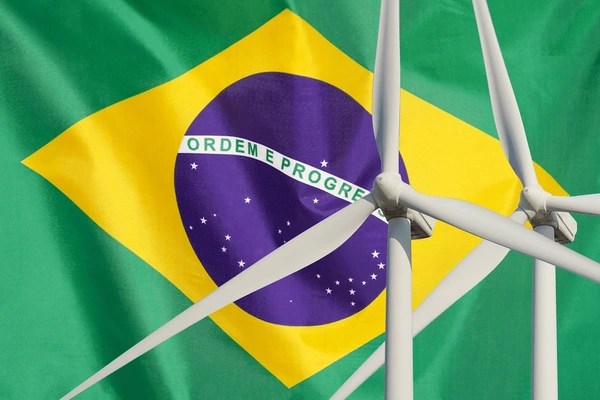
(Folhapress) The decision by the President of the United States, Donald Trump, to suspend new wind power projects in the country, arguing that windmills “kill their birds and ruin their beautiful landscapes”, has the potential to boost the interest of investors in this sector in the Brazilian market.
Trump’s action mainly halts future leasing of offshore wind projects, at the same time that this type of energy generation venture has just had a law sanctioned by President Luiz Inácio Lula da Silva, on the 11th. The Brazilian government intends to hold the first auction of areas in the sea for wind exploration in the second half of this year.
In the opinion of experts in the sector, the red light that the United States is giving for the energy transition should affect the positioning of several countries in the world. But this should be taken advantage of by Brazil, which has natural and economic advantages to accelerate in the opposite direction.
“For Brazil, in particular, this positioning ends up being an advantage. Trump signals that part of the world is less willing to pay the premium for renewable energy. He does this because, there, this energy is more expensive than other sources. However, in Brazil, the scenario is the opposite. Renewable sources are our bonus, because here this energy is cheaper”, says Paulo Pedrosa, president of the Brazilian Association of Large Industrial Energy Consumers and Free Consumers (Abrace).
The installation of offshore wind farms is still a marginal experience in the United States, with a low presence. Onshore wind farms, on the other hand, make the Americans the second largest user on the planet in terms of installed power.
Of the 945.5 Gigawatts of the world’s onshore wind energy park, 43% are in China, while 16% are produced by the Americans, according to the 2024 ranking of the Global Wind Energy Council (GWEC). Brazil appears in sixth place (3% of the total), behind Germany (7%), India (5%) and Spain (3%).
The scenario changes when it comes to offshore wind power, with China leading the way (50%), followed by the United Kingdom (20%), Germany (11%) and the Netherlands (6%). The United States does not even appear in the ranking.
By nullifying this market at its inception, Trump is driving away suppliers from this sector, most of them from China, and investors in wind projects, most of them concentrated in Europe.
“This setback in the climate and energy transition was already expected. But it is clear that, with the decision taken, there will certainly be a reversal in the capital path. There was a lot of money from the wind sector migrating to the United States]. Now, the market will seek another path and there is a tendency for investment to migrate to Brazil”, says Elbia Gannoum, president of the Brazilian Association of Wind Energy and New Technologies (Abeeólica).
The topic gains even more relevance in the country, due to the COP30 climate conference that will be held in Belém in November. “The government has given positive signals that it is working to hold the first offshore block sessions in the second half of the year,” says Gannoum.
Wind power has experienced significant growth in Brazil over the past 15 years, rising from a total capacity of 600 Megawatts (MW) in 2009 to more than 33,600 MW in 2024.
Over the next five years, another 23,200 MW are expected to come into operation in the country.
“The chessboard is being rearranged in the world. The United States is repositioning itself and this affects all countries. It is time for Brazil to step up to the plate, be different and use this to strengthen itself. This should be the discourse of the country and the government,” says Pedrosa.
Whatever the impact on the Brazilian market, it will not be immediate. Gannoum states that, on average, decisions and actions usually become reality in the market within two years, on average, due to the construction and investment period. In 2024, she says, there was a slowdown in the growth rate, due to factors that occurred two years earlier, such as the economic downturn, the large volume of rain that supplies hydroelectric plants and the growth of solar energy. The same effects should impact growth this year. From 2026 onwards, however, the outlook is for more investment to resume. Today, onshore wind energy accounts for 16% of Brazil’s total energy production capacity. The Brazilian Institute of the Environment and Renewable Natural Resources (IBAMA) had received 98 formal requests for licensing of offshore wind farms by the end of last year. Together, these projects require authorization to install 15,501 towers on the coast, which is equivalent to a total capacity of 234.2 Gigawatts.
Most of this generation is planned for the Northeast region (109 Gigawatts), followed by the South (75.3) and the Southeast (49.9). Many of these plans, however, overlap and will need to be revised.
 Brazil Energy Insight
Leave a comment