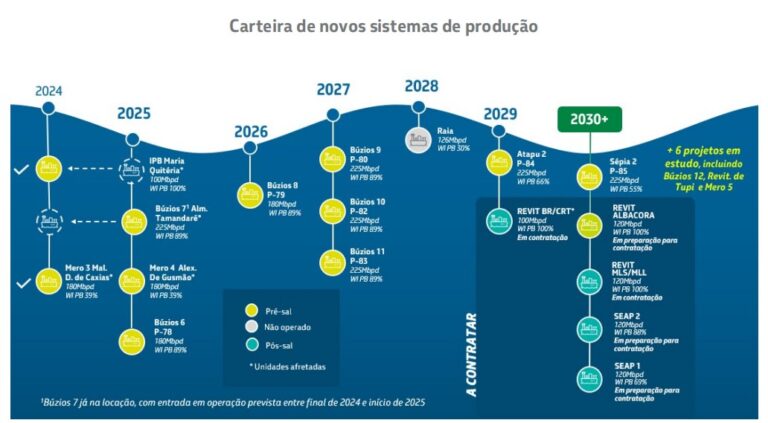
(PN) Petrobras’ new strategic plan for the five-year period 2025-2029 provided more information about the company’s plans regarding its fleet of platform ships (FPSOs). During the period, the company intends to start operating ten units by 2029, all in the pre-salt layer. In addition, the oil company also plans to build five more units beyond 2030, which will be installed in both the pre-salt and post-salt layers. The company’s plans also include six other projects under study, which reveals Petrobras’ central role in the global FPSO market over the next few years.
This large volume of orders also represents an additional challenge for the supply chain, which is already having difficulty obtaining financing to meet current demands. Recently, Petrobras’ Director of Engineering, Technology and Innovation, Renata Baruzzi, was in Singapore to talk to potential suppliers and understand the main difficulties encountered. The executive also mentioned that the company has already made adjustments to its contracting model to facilitate the participation of companies in tenders for platform vessels.
For 2025, Petrobras intends to start production of two units: FPSO Alexandre de Gusmão, in the Mero field, and P-78, in the Búzios field. The FPSO Almirante Tamandaré, which was due to produce its first oil next year, had its schedule brought forward and should start operating by the end of 2024, also in Búzios. This same field will receive another unit in 2026, the FPSO P-79.
In fact, as we have already reported, the company’s goal in Búzios is to reach the level of 1 million barrels of oil per day. Therefore, in 2027, three more platforms will begin extracting oil from the field: P-80, P-81 and P-83. In 2029, Petrobras will not begin operating any of its own projects, but will be working side by side with Equinor, operator of the Raia project in the Campos Basin, whose production is scheduled to begin that year.
In addition to the horizon of its business plan, the company also expects to begin production on five more platforms after 2030: P-85 (Sépia), Albacora Revitalization, Marlim Revitalization, Sergipe Águas Profundas 1 and Sergipe Águas Profundas 2. Finally, the company is studying six other projects, including Búzios 12, Tupi Revitalization and Mero 5. With this Plan, Petrobras expects to reach a total production of 3.2 million barrels of oil and gas equivalent per day (boed), or 2.5 million barrels of oil per day (bpd).
To meet the challenges of replenishing reserves, Petrobras increased investments in exploratory activities, totaling CAPEX of US$ 7.9 billion in the five-year period (5% higher than the previous plan). In parallel, the proposed planning also includes projects that aim to increase gas availability and a closer look at mature assets, with the objective of evaluating the possibilities of extending the productive life of these assets and their production systems and, ultimately, initiating decommissioning activities, following the best sustainability practices in the disposal of end-of-life assets. The sustainable disposal of equipment and abandonment of wells will require expenditures of US$ 9.9 billion over the next five years.
 Brazil Energy Insight
Leave a comment