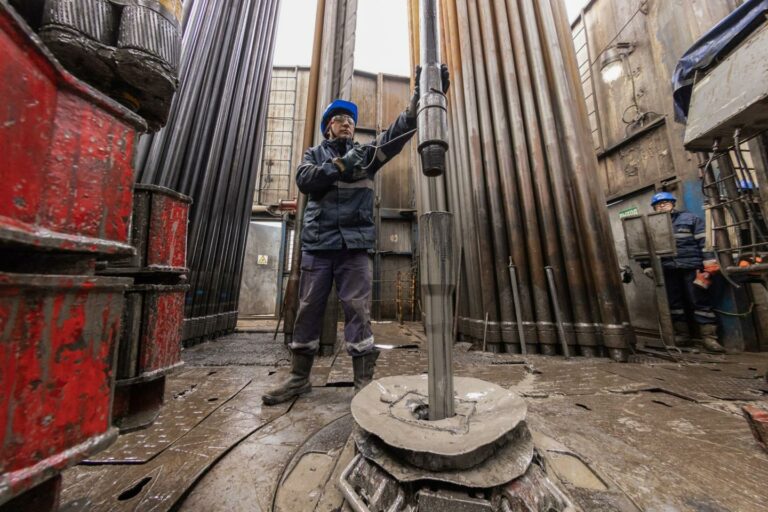
(PN) Brazil is expected to receive around R$10 billion in investments this year in oil and gas blocks that are in the exploration phase. The data was presented by the National Petroleum Agency (ANP), in the Annual Exploration Report (available on the ANP website). Of this amount, the offshore environment will receive R$9.50 billion, of which R$8.50 billion will be invested in well drilling. For the onshore environment, the forecast is R$470 million in investments this year. The document also highlights that 39 wells are expected to be drilled in 2024. If the forecast is confirmed, it will be a new record for the country, surpassing the best record recorded so far (27 wells, in 2019).
The report indicates the investments planned for the exploration phase based on the Exploration Work Plans (PTEs) for 2024 submitted to the ANP by the oil companies. In total, between 2024 and 2027, investments in exploration are expected to total R$18.31 billion. Of this amount, 88% will be concentrated in well drilling (R$16.04 billion), while the remaining 12% (R$2.27 billion) will be distributed between well testing (8%), exclusive geophysical survey (3%) and non-exclusive geophysical survey (1%).
In addition to the almost R$10 billion for 2024, the ANP foresees another R$7.64 billion in 2025, and R$701 million in 2026 and 2027. The exploration phase begins with the signing of contracts for the exploration and production of oil and natural gas. In this report, studies are carried out to detect the presence of oil and/or natural gas in the areas under contract, called blocks, in sufficient quantity to make their extraction economically viable. If successful in this stage, companies can move on to the next phase of the contract, the production phase, when they will begin production and the contracted area will be called a field.
The report also presents an overview of Brazil’s exploration in 2023. See the main points:
– The year 2023 ended with 251 blocks under contract, 13 under the production sharing regime and 238 under the concession regime. Between 2022 and 2023, there was a decrease of 44 blocks. The reduction can be attributed to two factors: the low number of contracts signed and the high number of blocks returned. In 2023, only four contracts were signed, while 48 blocks were returned. In December 2023, public sessions were held to present the bids for the 4th Cycle of the Permanent Concession Offer and the 2nd Cycle of the Permanent Production Sharing Offer. However, the contracts will only be signed in 2024.
– Regarding the blocks under contract by environment, in 2023, the onshore environment remained in the lead, with 151 blocks versus 100 blocks in the offshore environment, of which 18 are located in the pre-salt layer.
– Regarding the blocks under contract in 2023, the onshore environment recorded the largest contracted area (52%), approximately 84 thousand km², and the offshore environment, 48% of the area under contract, approximately 77 thousand km².
– As the main parameter for evaluating the performance of the oil and natural gas exploration segment, the drilling of exploratory wells has shown below-desirable performance over the last few years. The year 2023 confirmed the trend of drilling a maximum of one exploratory well for every ten blocks under contract, a result observed since 2016. In 2023, 22 wells were drilled in the exploration phase, one less than in 2022.
– In 2023, there were 14 wells with discovery notifications on land and four at sea. In the year, evidence of hydrocarbons was found only in wells drilled in the Santos and Campos basins, both with two notifications each. Of the 14 wells with discovery notifications in onshore basins in 2023, nine were registered in new frontier basins, Amazonas (6) and Parnaíba (3); and five in mature basins, Espírito Santo (4) and Recôncavo (1).
 Brazil Energy Insight
Leave a comment